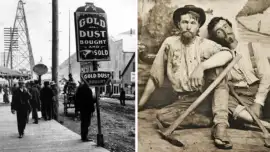
Left side shows a busy street with a "Gold Dust Bought and Sold" sign from the Klondike Gold Rush era. Right side features two miners resting with tools, wearing worn clothes, surrounded by a rustic setting.
Left: Getty, Right: collection of the Canadian Photography Institute. NGC, Ottawa

These historical photos from the American Gold Rush (1850s–1890s) capture a pivotal chapter in U.S. history. Rather than charts or financial records, what survives are striking images of miners, families, and frontier towns that defined the era. Each photograph is a preserved moment from the 19th century, showing the hardships, hope, and human stories behind one of the most transformative migrations in American history. From rough mining camps to growing settlements, these rare images document how the Gold Rush shaped culture, community, and daily life in the American West.

In January 1848, carpenter James Marshall spotted shiny flecks while building John Sutter’s sawmill near the American River. News of the find quickly emptied nearby towns as workers abandoned jobs to search for gold. Within a year, the story spread through national newspapers, and President Polk publicly confirmed the discovery.

This launched the California Gold Rush, prompting a massive influx of people. San Francisco’s population rocketed from around 500 residents in 1847 to over 150,000 by 1852. Prospectors from around the world, dubbed “forty-niners,” streamed west hoping to transform their lives.

1. Unknown miners taking a rest (circa 1860)

Two men with shovels sit on the ground in front of a painted backdrop depicting nature. Both wear hats and casual work clothes. One man leans on the other, suggesting camaraderie. The image has an old sepia tone.
collection of the Canadian Photography Institute. NGC, Ottawa

Early miners were often inexperienced; even doctors and merchants traded their professions for a pan and pick. They typically worked 10-14 hours a day, living in crude tents or makeshift cabins and enduring rampant crime and lawlessness in boomtowns.

The Gold Rush overwhelmingly attracted men (by 1852, about 92% of prospectors were male; the few women on the scene mostly ran restaurants, saloons, or hotels.

2. Mining on the American River near Sacramento (circa 1852)

Historic photo of miners at a busy gold mining site with rocky terrain and water. Numerous men and boys, dressed in early 20th-century clothing, are scattered across the scene, working with tools and machinery. Trees are visible in the background.
Wikimedia Commons

During the early years, miners relied on simple placer methods, panning and rockers (cradles) that used a hand-cranked box to wash dirt. The long tom, essentially a long wooden trough with a perforated sheet of iron, could process about 20 times more material than a rocker.

As surface gold dwindled, miners built sluice boxes and larger long toms that required cooperative labour and more water.

3. Portsmouth Square, San Francisco, during the gold rush (circa 1851)

A historical photograph of a small town with a row of wooden buildings in front of a hill. The storefronts include signs for various businesses. Sparse structures are scattered on the hill in the background, and a few people and horses are visible.
Wikimedia Commons

This is a block away from where the Transamerica Pyramid stands today.

4. Unknown bearded miner (circa 1852)

A man wearing a dark shirt and hat holds a pickaxe and a pan with gold nuggets. His expression is serious as he sits against a simple backdrop, evoking a historical or gold rush era setting.
collection of the Canadian Photography Institute. NGC, Ottawa

This daguerreotype is beautiful, and I also love that they painted the gold in the photo.

5. River Mining on the North Fork of the American River (circa 1850-1855)

Sepia-toned vintage photograph of a rural scene with several people standing near a large wooden waterwheel by a river. A small building with a slanted roof is in the background, surrounded by trees. The landscape is rocky and sloped.
Wikimedia Commons

6. Unknown miner posing with his tools (circa 1851)

A vintage black and white photo shows a man wearing a striped shirt and straw hat, holding a shovel and pickaxe crossed in front of him. He has a serious expression and holds a pan in one hand, suggesting a mining theme.
collection of the Canadian Photography Institute. NGC, Ottawa

Another beautiful daguerreotype photo.

7. Hydraulic mining operation (circa 1856)

Historic image of several miners using high-pressure water hoses for hydraulic mining in a large pit. The eroded earth and surrounding trees are visible, with wooden structures and workers at the top edge.
collection of the Canadian Photography Institute. NGC, Ottawa

By the 1860s, hydraulic mining emerged: pressurized water cannons blasted hillsides and washed gold-bearing gravel into sluices. This industrial method produced enormous volumes of sediment, clogging rivers and burning farmland, and eventually prompted one of America’s first environmental lawsuits, culminating in a 1994 court decision that restricted hydraulic mining.

8. Mining town with an American flag and men relaxing (circa 1852)

A sepia-toned historical photograph shows a dirt street lined with wooden buildings on both sides. Several people are seen walking and standing on the street. Trees are visible in the background, and a tall flagpole stands in the distance.
collection of the Canadian Photography Institute. NGC, Ottawa

Photos of old west towns are always so beautiful and haunting.

9. Miner Daniel J. Butler posing with gold and mining tools (circa 1850)

A vintage photograph of a man wearing a hat and holding a saw and pickaxe. He has a mustache and is dressed in a long-sleeve shirt with a scarf tied around his neck. The image has a sepia tone, giving it an antique appearance.
collection of the Canadian Photography Institute. NGC, Ottawa

The painting of the gold on this daguerreotype is a bit more haphazard, but it certainly does the trick.

10. Miners tending to their sluice (circa 1850s)

A historical black and white photo depicts a group of men in work attire standing beside a wooden sluice in a rocky area, likely a mining site. Buildings and equipment are visible in the background, indicating an industrial setting.
Wikimedia Commons

You can really feel the tension in photos like this one.

11. Two troublemakers posing with liquor, a gun, and a knife (circa 1850)

Two men in 19th-century attire sit side by side. Both wear dark jackets, bow ties, and brimmed hats. A small round table in front of them holds a bottle and two glasses. The image has a vintage, sepia-toned appearance.
collection of the Canadian Photography Institute. NGC, Ottawa

Something tells me the money in their pockets is not their own.

12. California Gold Rush miners with wagon, stock, and mining tools (circa 1860s)

Historical black-and-white image showing four men during the 19th-century Gold Rush. Two men dig at a sluice box filled with rocks, while another stands by a horse-drawn cart in the background. Trees and grassy terrain are visible.
columbiastatehistoricpark

I would love to know what the average cleanup looked like on small operations like this back then.

13. Miner panning for gold during the California Gold Rush

A person wearing a hat is crouching by a river with a pan, likely panning for gold. There are some bags and tools beside them. The water reflects trees from the surrounding landscape. The scene is in black and white.
columbiastatehistoricpark

This might be my favorite photo of the bunch. So haunting.

14. Gold miners in Idaho using a rocker box to placer mine for gold (circa 1885)

Old black and white photo of gold miners working with long wooden sluice boxes and shovels in a rocky area near a mine entrance. Several men are engaged in various tasks, surrounded by trees and equipment.

Graphic House/Staff/Getty

From the looks of this operation, they’ve probably found a quartz vein in the mountain they’re chasing in the mine, crushed the rocks, and sent them through that long tom sluice.

15. Prospectors posing with their equipment as they prepare to mine somewhere in the Northwestern United States (circa 1867)

A group of soldiers in uniform stand outdoors in front of a rustic wooden building. Some soldiers hold rifles and wear wide-brimmed hats. A military cannon is visible in the background, and men are seated on a platform above the ground.

Hulton Archive/Staff/Getty

Something worth noticing is how many more guns than shovels you see headed out to the claim.

16. Gold miners in Alaska weighing up their gold (circa 1897)

Two men in a rustic room weigh gold nuggets on a scale. One holds a bag, while the other balances a pan with gold flecks. Photos and papers hang and sit on the walls and shelves behind them.

Bettmann/Contributor/Getty

Between the bag, the scale, and that pan, that looks like a lot of gold.

17. Miners in Alaska using a long tom sluice and showing off their gold (circa late 1890s)

Four men in historical attire stand by a wooden sluice for gold panning. They hold mining tools and pans filled with gravel. A wooden bridge structure is visible in the background. The scene suggests gold mining activities.
Wikimedia Commons

Clearly, the gold rush was an incredible moment in American history. The struggle and survival of miners depended as much on hard work and perseverance as on luck, which made it an incredibly tricky and harrowing passage in this country’s not-so-distant past.

18. Gold Prospector in 1850, panning in a stream in California.

A black-and-white photo of an elderly man squatting by a river, panning for gold. He wears a wide-brimmed hat and rugged clothing, focused on his task with his hands submerged in the water, surrounded by stones.

Gado/Contributor

I cannot imagine the aches and pains you’d feel from doing this all day.

19. Deadwood, South Dakota, 1888.

A sepia-toned aerial view of a small 19th-century town surrounded by hills and dense forests. The town features wooden buildings, dirt roads, and scattered structures, capturing a historical rural setting amidst the natural landscape.
Heritage Images/Contributor

I love the TV show Deadwood, so it’s a real treat to see the real thing.

20. Chinese workers panning for gold in California.

Two miners in a barren landscape, panning for gold near a small stream. One stands with a pan, the other leans over the water, both wearing hats. In the background, a wooden sluice box and a small shack can be seen.
Hulton Archive/Stringer

Gold seekers came from Latin America, Europe, Australia, and Asia. By 1851, around 25,000 Chinese immigrants had traveled to California, seeking what they called “gam saan” (“mountain of gold”).

Anti-immigrant sentiment grew as gold became scarce. California’s legislature passed a Foreign Miners’ Tax in 1850, charging non-American miners $20 per month (equivalent to about $650 today).

21. Miner Panning for Gold in California, circa 1890.

A person in a brown hat and yellow shirt crouches by a river, panning for gold. The scene includes a metal pan with water and sediment, surrounded by rocks and greenery, illustrating a historical gold mining activity.

Bettmann/Contributor

The Gold Rush had catastrophic consequences for California’s Indigenous nations. Native people, estimated at 100,000-125,000 before the rush, lost access to land and resources; by 1900, only about 16,00 remained.

22. A portrait of a young man named Charles Edward Mitchell during the California gold rush.

A sepia-toned vintage portrait of a man wearing a wide-brimmed hat and a tie. He has dark hair and is dressed in a formal jacket. The image shows signs of aging, with visible spots and discoloration.
Canadian Photography Institute

This guy has pretty wild eyes.

23. A portrait of a gold prospector in 1852.

A sepia-toned photograph of a 19th-century man wearing a tall, wide-brimmed hat and a coat with large buttons. He has a serious expression and sits with his hand resting on his knee. The portrait has a vintage, weathered appearance.
Canadian Photography Institute

This man has the look of someone who will never trust another man again.

24. An unidentified man with gold mining equipment, 1865.

A sepia-toned portrait of a man in 19th-century work attire holding a shovel. He wears a hat and stands in front of a neutral backdrop. The ornate frame has gold detailing, enhancing the vintage appearance.
Library of Congress

The frame is almost as beautiful as the tintype photo itself.

25. Gold miners in El Dorado, California, between 1848 and 1853.

A vintage photo of eight men working on a hillside excavation with shovels and wheelbarrows, near a wooden cabin and a stream. Trees cover the hill in the background. The scene appears to be from a historical mining or construction site.
Library of Congress

After a long, grueling day mining, I bet those two dogs were some comforting company.

26. Gold prospectors prepare their boat for the 1400-mile journey home from a gold mining expedition in Alaska circa 1897.

A group of men in hats and jackets work together to launch a small sailboat into a river. The scene is set against a backdrop of a forested hillside under a cloudy sky, suggesting a rugged, wilderness setting.

Archive Photos/Stringer

A 1400-mile trip on that tiny boat is quite the adventure.

27. Gold prospectors going to the new field in 1889

Sepia-toned historical photo of a group of men with oxen pulling a covered wagon on a rocky path in a mountainous area. The men wear 19th-century work clothes and hats. Sparse trees dot the background landscape.

Heritage Images/Contributor

28. Gold miners posing with pickaxes, shovels, and sieves in 1853.

A vintage photograph shows a group of men wearing hats and work clothes standing by a riverbank. Some hold shovels and pans, suggesting they are gold prospectors. Trees are visible in the background, and the scene is framed with an ornate border.

Heritage Images/Contributor

George Howard Johnson shot this beautiful Daguerreotype photo.

29. Placerville, California, circa 1890s
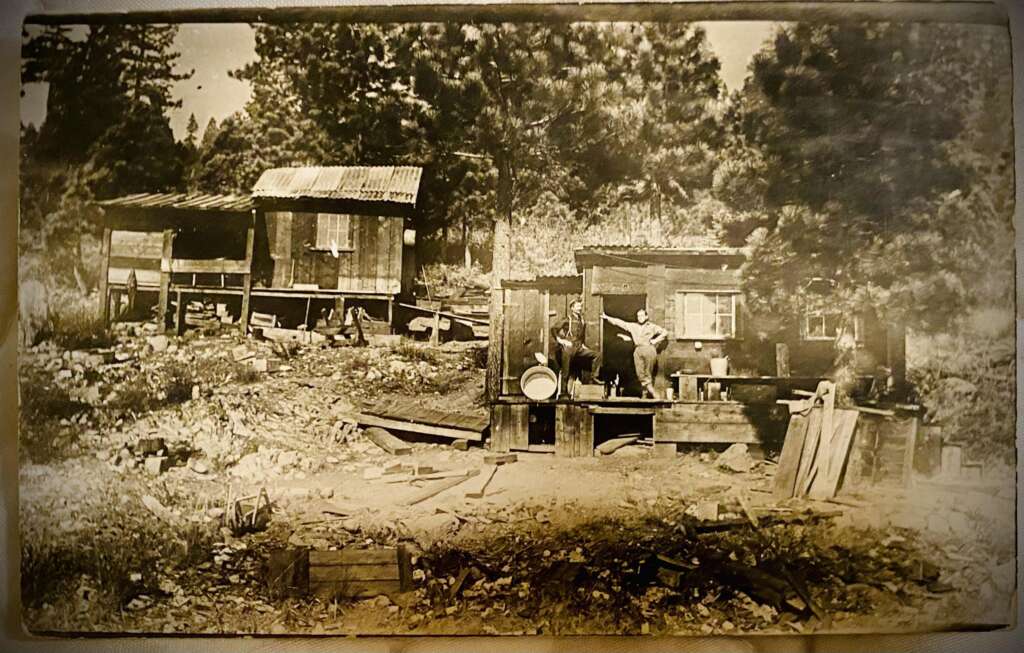
Sepia-toned image of two rustic wooden cabins in a forest setting. Three people stand on the porch of the front cabin. The area is strewn with wooden debris and has a rugged, early 20th-century frontier appearance.
DiamondNo4475

The couple pictured were miners who came to California by wagon train. They were miners before homesteading in the Placerville area.

30. An 1854 Daguerreotype
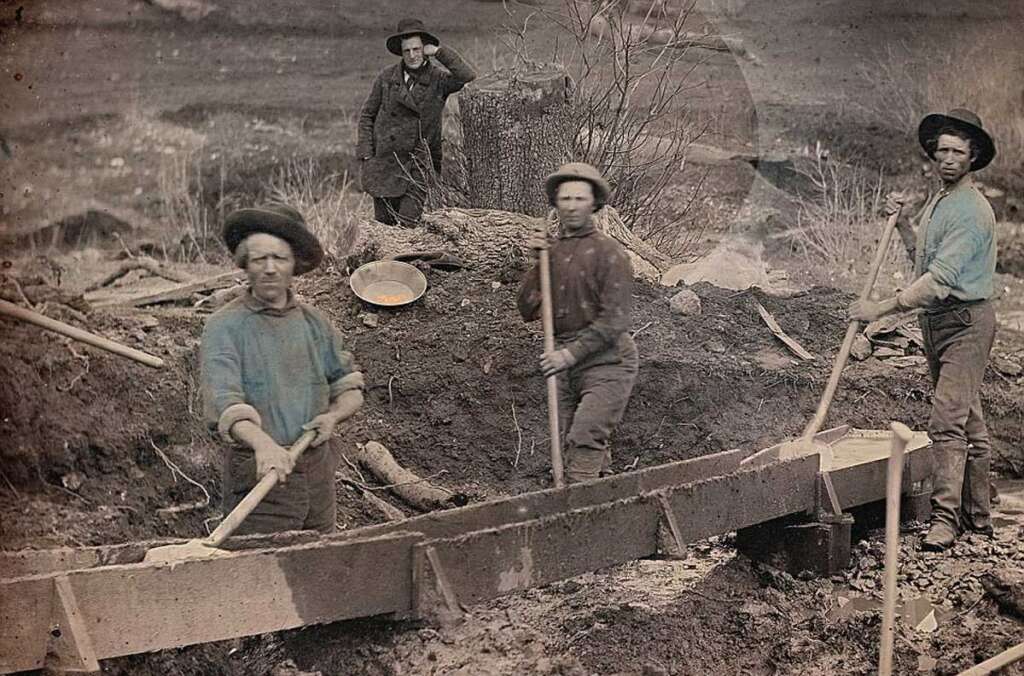
Four men work outdoors at a mining site, using tools to sift through soil in a wooden sluice box. They wear old-fashioned clothing and hats; one man stands in the background observing the scene.

Dig deeper into frontier life with 30 Vintage Photos Showing Life on the American Frontier, meet legendary gunslingers in 25 Real Photos of Wild West Icons From 1860-1910, or belly up to frontier watering holes in 23 Vintage Photos of Old Wild West Saloons.

Meet the Writer

With over 15 years in digital publishing, Colby Droscher is a veteran of the industry. In a past life he was the Editor-in-Chief of Literally Media’s Entertainment brands (Cracked.com, eBaumsWorld.com, Cheezburger.com). His specialities are online humor, digital culture, memes, videos games, tv & movies and the history of the internet.