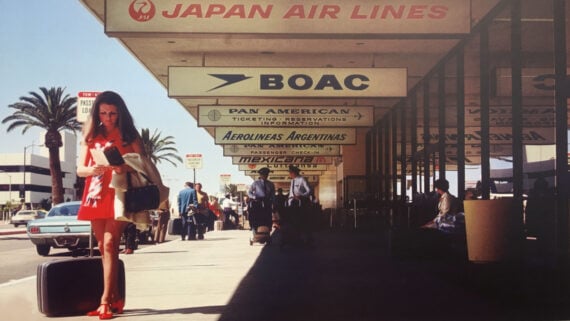
A woman in a red dress and heels stands with a suitcase outside an airport terminal lined with retro airline signs, including Japan Air Lines, BOAC, Pan American, and Mexicana. Palm trees and cars are in the background.

Travel used to be an adventure, sometimes glamorous, sometimes chaotic, often downright surprising. Before apps, TSA lines, digital maps, and lightweight luggage, people navigated the world with habits that feel almost unbelievable today.

These 18 travel behaviors from the ’60s through the ’90s show how dramatically the travel experience has changed, and how wild things really were.

1. Bringing Giant Suitcases With No Wheels

Two vintage Louis Vuitton suitcases with brown leather trim and handles sit stacked on a wooden floor by a white couch. The suitcases feature the iconic LV monogram pattern.
louisvuitton/via reddit.com

Before rolling luggage existed, travelers carried everything by hand. Airports were filled with people lugging massive bags like they were on a fitness challenge.

2. Dressing Up for Flights

A woman in a red dress stands at an airport terminal curb with a suitcase. Overhead signs display airline names like Japan Air Lines, BOAC, Pan American, Aerolineas Argentinas, and Mexicana. Palm trees line the street.
thewaywewere/via reddit.com

Heels, suits, dresses, pearls, and flying were practically a red carpet event. Travelers looked more like they were attending a gala than getting on a plane.

3. Showing Up at the Airport With No Reservation

Black and white photo of men in suits and hats standing and talking in an airport terminal near signs reading "EXPRESS LINE PASSENGERS WITH NO HAND-CARRY ITEMS" and "DO NOT ENTER! DEPLANING OF PASSENGERS ONLY.
nostalgia/via reddit.com

You could just walk up to the counter, buy a ticket, and hop on the next flight. No apps, no advance booking, no panic-fueled price comparisons.

4. Airplane Meals Served Like Fine Dining

Flight attendants and a chef serve gourmet food and drinks to passengers seated in a spacious, retro-styled airplane cabin. The passengers appear relaxed, enjoying the luxurious in-flight service.
oldschoolcool/via reddit.com

Think metal cutlery, real plates, multi-course meals, and menus printed on cardstock. Today’s travelers can only look at photos and sigh.

5. Collecting Paper Tickets Like They Were Gold

A vintage Australian National Airways passenger ticket and baggage stub for C.H. Parker, traveling from Perth to Melbourne and returning in January 1950. Handwritten details and airline logos are visible.
oldschoolcool/via reddit.com

Lose your physical ticket? That was it, your trip was over. Travelers guarded them like priceless documents.

6. Hitchhiking as a Normal Travel Option

A vintage photo shows passengers on an airplane, many standing and smiling with drinks in hand. Some are seated, and the interior has cream and yellow seats with overhead bins. The mood appears lively and celebratory.
anonymous/via reddit.com

Through the ’60s and ’70s, especially, catching rides with strangers was seen as adventurous and budget-friendly. Today, it’s almost unimaginable.

7. Navigating With Fold-Out Maps

A historical map of Central Europe titled "Höhen-Karte von Mittel-Europa," showing countries, borders, and mountain ranges with a legend listing regions. The map highlights the Alps and surrounding areas with shaded relief.
anonymous/via reddit.com

Huge paper maps covered dashboards, laps, and sometimes entire steering wheels. Refolding them correctly was an Olympic-level skill.

8. Choosing Hotels From Thick Travel Catalogs

A vintage magazine ad shows a smiling man in a suit with arms open wide in front of a large house. The caption reads, "BOAC takes good care of you." Various bottles are visible on the table in the foreground.
casualuk/via reddit.com

Travelers flipped through printed brochures filled with illustrations, not real photos. Reviews didn’t exist—just trust and hope.

9. Letting Kids Roam Freely in the Back Seat

A group of eight smiling children sit in the back of a station wagon. Some wear striped socks and "I ♥ NY" t-shirts. The photo has a vintage, 1970s or 1980s feel.
nostalgia/via reddit.com

Road trips meant unbelted kids crawling between seats, lying on pillows, or leaning out windows. A totally different era of car travel.

10. Staying in Motels Completely Blind

A vintage bedroom with a double bed covered in a pink bedspread, a wooden TV stand with an old television, armchairs, blue curtains, a lamp, floral decorations, and a bird painting on the wall.
vintage/via reddit.com

You pulled off at whatever motel sign looked decent and hoped the room inside didn’t surprise you. There were no ratings, only vibes.

11. Taking Photos Without Knowing the Results

Three vintage cameras—a Zenit, a GOMZ Smena, and a Praktica—are displayed side by side on a white surface in front of a classic radio with dials and buttons.
buyitforlife/via reddit.com

People wouldn’t see their vacation pictures until they got home and developed the film. Half the memories were blurry or overexposed.

12. Matching Souvenir T-Shirts for the Entire Family

A man and woman sit outdoors on grass, leaning against a log. Both wear colorful patchwork shirts and wide blue bell-bottom jeans. The woman has pink-tinted sunglasses, and they appear relaxed and close together.
70s/via reddit.com

Vacation uniformity was a thing. Matching shirts, matching hats, matching everything.

13. Booking Flights Over the Phone

A man in a suit holds an early mobile phone and a briefcase, smiling on a city sidewalk. Behind him, people stand near phone booths and cars line the street with tall office buildings in the background.
nostalgia/via reddit.com

Hours on hold, reading credit card numbers out loud, and hoping the agent typed your name correctly. A far cry from today’s one-click bookings.

14. Using a Massive Road Atlas

Cover of a Rand McNally Road Atlas featuring three vertical scenic images: flowering trees, a waterfall, and a winding road through trees. The title text appears at the top in red and black.
12keys/via reddit.com

Families navigated using atlases thicker than dictionaries. One outdated map could reroute an entire vacation.

15. Packing Homemade Food for the Road

A man sits at a table with a plate of donuts and a large box labeled "DONUTS." He is holding up a donut and looking toward the camera. The background is plain and brownish-orange.
oldschoolcool/via reddit.com

Coolers full of sandwiches, snacks, and drinks were essential. Fast food was a rare treat, not the default.

16. Endlessly Long Bus Trips

Four people, three men and one woman, stand in front of a vintage blue bus on a road. They are casually dressed in 1970s-style clothing and appear relaxed, leaning against the bus and smiling.
oldschoolcool/via reddit.com

Buses stopped in every tiny town along the route, turning short trips into full-day journeys. People accepted it as normal travel.

17. Traveling With Giant Camcorders

A person in a light blue shirt holds a large RCA video camera on their shoulder in a vintage kitchen with wood cabinets, yellow plaid wallpaper, and a blender on the counter.
nostalgia/via reddit.com

Capturing family memories required devices so large they needed their own bag, and their own shoulder workout.

18. Using Traveler’s Checks

A vintage American Express Company traveler’s cheque for $20, featuring a purple border, a portrait of a woman in profile, serial number Z66-697-580, and signatures on a wooden surface.
papermoney/via reddit.com

Before debit cards, traveler’s checks were the safest way to carry money. Cashing them felt like a secret mission.

Explore more vintage content:

Looking back at these travel habits from the ’60s through the ’90s reminds us just how much the world has changed—and how quickly. What once felt normal now seems wild, charming, or downright inconvenient compared to the streamlined travel of 2025. Yet there’s something undeniably nostalgic about the spontaneity, the simplicity, and even the chaos of vintage travel. If you loved this content, check out 35 Vintage Photos of the Early to the Mid-1970s, or 20 Vintage Photos of Ruins Before Tourism (1800s-1900s).


Meet the Writer