We often look to high-budget Hollywood blockbusters to see world-ending storms or alien-looking skies, but the truth is that our own atmosphere is capable of producing sights far more bizarre than anything rendered in a studio. These natural phenomena occur when the perfect combination of temperature, pressure, and light creates visual anomalies that seem to break the laws of physics. Whether it’s a glowing orb of electricity or a cloud formation that looks like a fleet of UFOs, Mother Nature has a way of reminding us that the planet is much more mysterious than we realize.
Chasing these rare occurrences has become a passion for photographers and scientists alike, as many of these phenomena only last for a few seconds before vanishing forever. Because they are so infrequent, witnesses often mistake them for supernatural events or secret government experiments, leading to decades of urban legends and myths. However, thanks to modern meteorology, we can now explain the complex science behind these cinematic displays without losing any of the magic. Let’s take a look at fifteen times the sky decided to show off with some of the most breathtaking and terrifying special effects in the natural world.
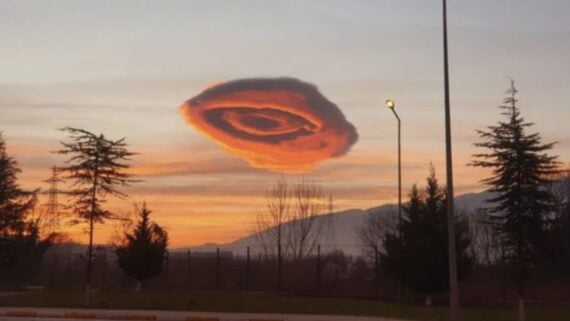
1. Lenticular clouds – The UFO clouds

Often spotted near mountain peaks, these stationary, lens-shaped clouds are the most frequent cause of “flying saucer” sightings across the globe. They form when moist air flows over a mountain range, creating a series of standing waves that condense into these perfectly smooth, circular discs. Interestingly, pilots actually avoid flying near them because the air currents required to create these shapes are often accompanied by severe turbulence. They look like a fleet of alien ships parked in the sky, but they are simply nature’s way of showing us how wind moves over the earth.
2. Catatumbo lightning – The eternal storm

In a specific spot in Venezuela where the Catatumbo River meets Lake Maracaibo, lightning strikes up to 280 times per hour for nearly 160 nights a year. This relentless display of electricity is fueled by the collision of mountain winds and methane gas rising from the surrounding marshes. It produces so much light that it has been used as a natural lighthouse for sailors for centuries, and it is considered the single largest generator of tropospheric ozone on the planet. Seeing it in person feels like watching a sci-fi war zone, yet it’s a localized weather cycle that has existed for millennia.
3. Asperitas clouds – The undulating sky

Only officially recognized as a distinct cloud type in 2017, Asperitas clouds look like the surface of a dark, choppy ocean viewed from beneath the waves. Despite their ominous, apocalyptic appearance, they usually dissipate without actually producing a storm or heavy rain. Scientists believe they are formed when cold, sinking air creates a chaotic “ripple” effect in the cloud base, resulting in a mesmerizing, three-dimensional texture. They are a favorite for time-lapse photographers because the way they churn and roll across the horizon looks like something out of a disaster movie.
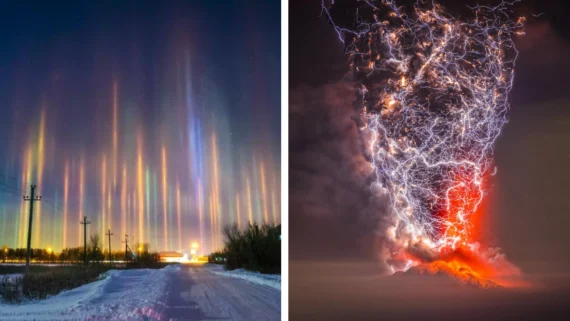
4. Volcanic lightning – The dirty thunderstorm

When a volcano erupts with enough force, it can produce its own localized weather system, complete with bolts of lightning shooting directly out of the ash plume. This occurs because the friction between ash particles and volcanic glass creates massive amounts of static electricity that eventually discharges as a bolt. It is one of the most visually striking sights on Earth, combining the orange glow of molten lava with the piercing blue of an electric storm. This phenomenon is often called a “dirty thunderstorm,” and it serves as a terrifying reminder of the raw power contained beneath our feet.
5. Fire whirls – The “firenado”

Fire whirls, or fire tornadoes, occur when intense rising heat and turbulent wind conditions combine to create a spinning vortex of flame. These terrifying towers of fire can reach heights of up to 150 feet and move with the speed and unpredictability of a standard tornado. While they look like a supernatural curse, they are actually a byproduct of extreme wildfires where the fire creates its own wind patterns. Some of the most intense fire whirls can actually uproot trees and pick up debris, carrying the flames across fire lines and making them a nightmare for firefighters.
Trending on The Scroller


6. Light pillars – The frozen beams

During extremely cold nights, vertical shafts of light can appear to beam directly into the sky from the ground, looking like an alien abduction is in progress. This effect is created when artificial light from streetlamps reflects off millions of tiny, flat ice crystals floating in the air near the surface. Unlike a standard searchlight, these pillars aren’t actually beams; they are an optical illusion that exists only in the eye of the observer. They are most commonly seen in Arctic regions or during severe polar vortex events, turning ordinary parking lots into otherworldly landscapes.
7. Supercell storms – The spaceship formation

A supercell is a massive, rotating thunderstorm that looks like a giant mothership descending from the clouds. These storms are characterized by a deep, persistently rotating updraft called a mesocyclone, which gives them their distinctive “stacked plate” appearance. They are the rarest and most dangerous type of storm, capable of producing giant hail and violent tornadoes that can last for hours. Seeing one on the open plains of the Midwest is a humbling experience, as the sheer scale of the rotation makes it look like the entire sky is being swallowed.
8. Sun dogs – The three suns effect

Sun dogs are bright, rainbow-colored patches of light that appear on either side of the sun, creating the illusion that there are three suns in the sky at once. They are caused by the refraction of sunlight through hexagonal ice crystals in high-altitude cirrus clouds, which act like tiny prisms. When the sun is low on the horizon, these “mock suns” become incredibly vivid and can even be accompanied by a glowing halo that encircles the sky. They have been documented since ancient times, often being interpreted as omens of major political or military changes.
Sign up for our newsletter
9. Moonbows – The ghost rainbows

A moonbow is exactly what it sounds like: a rainbow produced by moonlight rather than direct sunlight. Because the moon is much dimmer than the sun, these “ghost rainbows” usually appear white or faint gray to the naked eye, though a long-exposure camera can reveal their full spectrum of colors. They require a very specific set of conditions, including a near-full moon that is low in the sky and a source of mist or rain opposite the observer. They are most famously sighted near massive waterfalls like Victoria Falls or Cumberland Falls during the right lunar phase.
10. Red sprites – The space lightning

Red sprites are large-scale electrical discharges that occur high above a thunderstorm in the mesosphere, reaching heights of up to 50 miles. They look like giant, glowing red jellyfish with long, thin tentacles reaching down toward the clouds below. For decades, pilots reported seeing these flashes, but they were dismissed as hallucinations until they were finally captured on film in 1989. They only last for a few milliseconds, making them incredibly difficult to see with the naked eye, yet they are essential for understanding the electrical balance of our planet’s upper atmosphere.
11. Bioluminescent waves – The neon surf

While this is technically caused by living organisms, the visual effect in the surf looks like a neon blue chemical spill from a sci-fi movie. When certain types of plankton are disturbed by the movement of the waves, they emit a burst of light as a defense mechanism, turning the entire shoreline into a glowing blue masterpiece. This phenomenon is most spectacular during a “red tide,” where the water is thick with these tiny organisms during the day and transforms into a light show at night. Walking along a beach where your footprints glow in the dark is an experience that feels 100% supernatural.
12. St. Elmo’s fire – The sailor’s glow

This phenomenon is a bright blue or violet glow that appears on pointed objects like ship masts, aircraft wings, or lightning rods during a storm. It isn’t actually fire, but a continuous electrical discharge called a “corona discharge” that occurs when the air becomes highly charged. Throughout history, sailors viewed it as a divine sign of protection, while modern pilots see it as a beautiful, glowing aura around their windshields. It is one of the few weather phenomena that you can actually hear, as it often produces a faint “hissing” or crackling sound as the electricity bleeds into the air.
13. Waterspouts – The ocean twister

A waterspout is essentially a tornado that forms over water, creating a massive funnel that appears to suck the ocean up into the sky. While some are “tornadic” and move from land to water, most are fair-weather spouts that form from the water surface up toward a developing cloud. They can be incredibly graceful to watch, but they are capable of capsizing small boats and even lifting marine life into the air, which is how the legend of “raining fish” started. They are a common sight in tropical areas like the Florida Keys, where the warm water provides the perfect fuel for these aquatic vortexes.
14. The morning glory cloud – The roll cloud

This incredibly rare cloud formation looks like a giant, horizontal tube that can stretch for over 600 miles across the horizon. It is a type of “roll cloud” that forms at a low altitude, traveling at speeds of up to 40 miles per hour without changing its shape. The most consistent place to see them is in the Gulf of Carpentaria in Northern Australia, where the specific shape of the peninsula creates the perfect wind conditions. Seeing a solid wall of cloud rolling toward you like a giant steamroller is a disorienting experience that feels like the end of the world.
15. Ball lightning – The forbidden sphere

Ball lightning is one of the most mysterious atmospheric phenomena, described as a glowing, grapefruit-sized orb of electricity that can float through walls or even inside airplanes. Unlike traditional lightning which lasts for a fraction of a second, these spheres can hover and hiss for several seconds before silently vanishing or exploding with a loud bang. For centuries, scientists believed it was a myth, but recent lab experiments and high-speed footage have confirmed that these floating orbs are very real. It remains one of the greatest “unsolved” mysteries in weather science, as we still don’t fully understand how the energy stays contained in a sphere.
Explore more fan facts:
It’s truly a marvel that we don’t need a ticket to the cinema to see the world’s most impressive visual displays; we just need to look up at the right time. These rare phenomena remind us that the atmosphere is a living, breathing canvas of light and physics that is constantly evolving. If you’re in the mood to explore more things that seem too strange to be true, don’t miss these 20 Reality Glitches That Are Actually Real Facts, or these 20 Fun Facts That Sound Fake (But Are Completely True). You can also check these 18 Historical Facts That Sound Fake Until You Check Them.