
We like to think that the universe follows a strict set of logical rules, but every now and then, we stumble upon facts that seem to suggest the “code” of our reality is a bit buggy. Whether it’s an animal that appears to have been designed by a committee or a geological event that defies the laws of physics, these anomalies make us stop in our tracks. These moments of high-strangeness remind us that for all our scientific progress, there are still corners of the world where logic takes a backseat to the surreal.
Finding these biological and historical “glitches” is like peeling back a layer of the world to see the messy wiring underneath. The most fascinating facts are the ones that challenge our common sense and make us feel like we’ve stepped into a sci-fi movie. From objects that move on their own to survival stories that should be impossible, reality is often far more imaginative than any simulation could ever be. Let’s explore twenty instances where the world simply forgot to make sense.
1. The silent forest of Aokigahara

This forest at the base of Mount Fuji sits on a bed of hardened volcanic rock that is incredibly porous and full of tiny holes. These holes absorb sound waves, creating an unnaturally quiet environment that feels “muffled,” as if the audio settings for the world have been turned down. Furthermore, the high iron content in the soil often causes magnetic compasses to fail, making it a literal dead zone for navigation.
2. The lake that disappeared in three days

In 2017, the Riesco Lake in Chile completely vanished in less than 72 hours, leaving behind a dry crater and confused locals. Geologists believe a giant sinkhole opened up on the lakebed due to seismic activity, essentially pulling the plug on the entire ecosystem. It looked like a map-rendering error in a video game where a giant texture simply fails to load.
3. The dragon’s blood tree

Native to the Socotra archipelago, the Dracaena cinnabari looks like a giant, inside-out umbrella and bleeds a thick, crimson resin when its bark is pierced. This “blood” was so highly valued in the ancient world that it was used as medicine, magic ink, and even violin varnish. Its alien appearance and red sap make it look like a plant that was ported over from another planet’s biome.
4. Vantablack: The color that looks like a hole

Vantablack is a substance made of carbon nanotubes that absorbs 99.96% of all visible light, making it the “blackest” material ever created. When you look at an object coated in it, your eyes can’t perceive any 3D depth, making the object look like a flat, two-dimensional void. It’s like a visual error in reality, where a part of the world has been deleted and replaced with nothingness.
5. The frozen woman who walked away

In 1980, a woman named Jean Hilliard was found frozen solid in a ditch after her car stalled in -22°F weather. When doctors found her, her skin was so hard they couldn’t even pierce it with a needle, yet she eventually thawed out and made a full recovery with zero brain damage. It is a biological anomaly that doctors still struggle to explain, as if her body simply “paused” its vital functions to avoid a crash.
Trending on The Scroller


6. Clouds that look like UFOs

Lenticular clouds form when moist air flows over a mountain, creating stationary, saucer-shaped structures that look exactly like alien spacecraft. They don’t move with the wind like normal clouds, often sitting in the same spot for hours while the air passes through them. These “glitches” in the sky are the number one cause of UFO sightings in mountainous regions across the globe.
7. The underwater “river” in Mexico

Hidden inside the Cenote Angelita cave in the Yucatan Peninsula, divers have discovered what looks like a flowing river complete with trees and leaves, all 100 feet underwater. This “glitch” is actually caused by a thick layer of hydrogen sulfide that separates fresh water from salt water, creating a foggy “riverbed” that moves independently of the surrounding ocean. It’s a surreal landscape that feels like a hidden level in a video game.
8. The zone of silence in Mapimi, Mexico

There is a specific patch of desert in Mexico where radio signals fail, compasses spin out of control, and satellites literally fall from the sky. In 1970, a U.S. test missile veered off course and landed here for no clear reason, adding to the area’s reputation as a magnetic “black hole.” Locals claim that even the sunlight feels different there, as if the laws of physics are being dampened by an invisible force.
Sign up for our newsletter
9. A fungus that controls the minds of ants

The Ophiocordyceps fungus is a real-life “zombie” virus that infects ants and completely takes over their motor functions. It forces the ant to climb to a high leaf and bite down with a death-grip before the fungus sprouts a stalk out of the ant’s head to release more spores. It’s a terrifying example of nature’s code being rewritten by a parasite to ensure its own survival.
10. The 400-year-old shark

The Greenland shark is a vertebrate that can live for over four centuries, meaning there are sharks swimming today that were alive before the United States was founded. They grow at a glacial pace of about one centimeter per year and don’t even reach sexual maturity until they are 150 years old. This extreme longevity feels like a time-scaling error in the biological clock of the ocean.
11. The boiling river of the Amazon

Deep in the Peruvian Amazon lies the Shanay-Timpishka, a 4-mile-long river where the water is so hot it can literally cook animals that fall into it. Most thermal rivers are located near volcanoes, but this one is over 400 miles away from the nearest active volcano, defying geological explanation. Scientists believe it’s powered by a fault-fed geothermal system that acts like a massive underground plumbing “leak.”
12. Square waves in the ocean

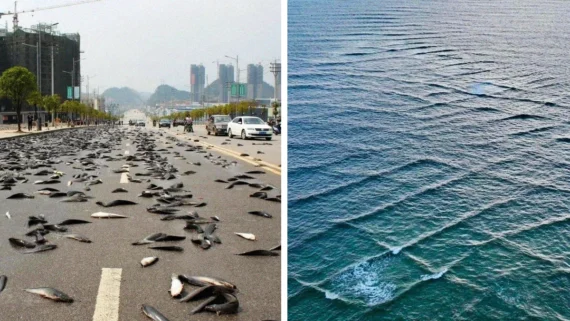
“Cross seas” occur when two weather systems collide, causing waves to crash into each other at right angles and create a perfect grid of squares on the water’s surface. While they look beautiful and orderly from a distance, they are incredibly dangerous because they create powerful currents that can pull swimmers and ships in two directions at once. It’s a visual glitch that looks like the ocean’s rendering engine has switched to wireframe mode.
13. The blood falls of Antarctica

At the edge of the Taylor Glacier, a waterfall of deep red liquid spills onto the white ice, looking like a scene from a horror film. This “blood” is actually hypersaline water that has been trapped beneath the ice for two million years, becoming rich in iron. When it finally escapes and hits the oxygen in the air, it “rusts” instantly, turning the water into a vivid, crimson stain.
14. The “hum” of Taos, New Mexico

For decades, residents of Taos have been plagued by a low-frequency hum that sounds like a diesel engine idling in the distance. Despite numerous scientific investigations, no one can find the source of the noise, and only about 2% of the population can actually hear it. It’s a localized acoustic glitch that has led to theories ranging from secret military experiments to a simple mass auditory illusion.
15. A plant that looks exactly like a stone

Lithops are South African succulents that have evolved to look identical to small pebbles or stones to avoid being eaten by hungry animals. They sit flush with the ground, showing only a small, translucent window at the top to let in sunlight for photosynthesis. To a casual observer, it looks like a geological error where a rock has suddenly sprouted a flower.
16. The lake that turns animals into statues

Lake Natron in Tanzania has a pH level so high and water so salty that it can calcify any animal that dies in its waters, essentially turning them into mummified “statues.” Photographer Nick Brandt famously captured eerie images of birds and bats that were perfectly preserved by the lake’s unique chemistry. The water is so caustic that it can strip the skin off animals that aren’t adapted to its extreme “code.”
17. The town where it rains fish

In Yoro, Honduras, a phenomenon known as the “Lluvia de Peces” has occurred almost every year for over a century. After a massive thunderstorm, the streets are found littered with hundreds of small, silver fish that the locals then collect and cook. While some scientists suggest the fish are picked up by waterspouts, others believe the fish live in underground rivers and are washed up by the heavy rains.
18. The “moving stones” of Death Valley

At Racetrack Playa, giant boulders have been moving across the flat desert floor for decades, leaving behind long, winding trails without any human or animal help. For years, people thought it was a supernatural “glitch,” until researchers discovered that thin sheets of ice and light winds were nudging the rocks along. It is a slow-motion phenomenon that makes the earth look like it’s shifting on its own.
19. Birds that can “see” the Earth’s magnetic field

Migratory birds like robins have a special protein in their eyes called cryptochrome that allows them to “see” the planet’s magnetic field as a visual overlay. This biological “HUD” (Heads-Up Display) helps them navigate thousands of miles with pinpoint accuracy. It’s as if their vision has been upgraded with a specialized navigation mod that humans simply weren’t programmed with.
20. The butterfly that tastes with its feet

When a butterfly lands on a flower or a leaf, it isn’t just resting; it’s using sensors on its feet to “taste” the plant’s chemicals. These sensors, called chemoreceptors, are 200 times more sensitive than human taste buds, allowing the butterfly to decide if a plant is safe to eat or lay eggs on. It’s a strange sensory “glitch” that puts their mouthparts and their feet in a completely different order than ours.
Want more fun facts?
These bizarre facts are proof that nature has a sense of humor and that the world is far more mysterious than we often assume. When you start looking for these “glitches,” you realize that reality isn’t a fixed set of rules, but a constantly evolving puzzle. If you enjoyed this dive into the surreal, be sure to check out these 20 Fun Facts You’ll Wish You Learned in School, or these 20 Fun Facts That Sound Fake (But Are Completely True). You can also take a look at these 20 Ocean Facts That Might Spark Thalassophobia.