We live in an age where satellites can zoom in on our front doors and DNA can trace our ancestors back thousands of years, yet there are still certain places on Earth that refuse to give up their secrets. From geological anomalies that seem to defy gravity to ancient structures built with precision that modern machinery struggle to replicate, our planet is dotted with “impossible” locations. These sites act as a humbling reminder that nature and history still hold a few wild cards that don’t fit into our neat, academic boxes.
Exploring these enigmatic places often feels like stepping onto the set of a science fiction movie, but the mysteries are very much real. Whether it is a river that boils at temperatures high enough to cook anything that falls in or a silent zone where radio signals simply vanish into thin air, these locations challenge our understanding of the natural world. We have rounded up twenty of the most baffling spots across the globe that continue to leave the world’s brightest minds scratching their heads in wonder.
1. The boiling river of Mayantuyacu – Peru

Deep in the heart of the Amazon, there is a four-mile stretch of river that reaches temperatures of up to 200°F, hot enough to kill any animal that accidentally falls in. While most thermal rivers are located near active volcanoes, the nearest volcanic center to Mayantuyacu is over 400 miles away. Scientists are still trying to understand the geothermal plumbing system that allows the Earth’s lifeblood to heat water to such an extreme degree in this specific spot. Local shamans believe the water is heated by a giant serpent spirit, and for now, that explanation is almost as scientifically plausible as any other.
2. The Nazca lines – Peru

These massive geoglyphs etched into the high desert plateau of Peru feature hundreds of figures, ranging from simple lines to complex depictions of monkeys, spiders, and hummingbirds. The greatest mystery isn’t just how they were made without an aerial view, but why they were created on such a gargantuan scale that they can only be fully appreciated from the sky. Despite decades of study, researchers are split between theories of astronomical calendars, irrigation maps, or ritualistic pathways. The precision of the lines, which have survived for over 2,000 years, remains one of the world’s most enduring archaeological puzzles.
3. The Zone of Silence – Mexico

In a patch of desert in Durango, Mexico, there is a strange area where radio signals, cell phones, and compasses simply stop working. This Mapimí Silent Zone first gained international attention in the 1970s when a US test missile went off course and crashed directly into the center of the region. Researchers have noted that the area has an unusually high concentration of meteorite strikes and strange biological mutations in the local flora. While some suggest high magnetic deposits are to blame, the exact reason for this communications blackout remains a scientific enigma.
4. The Stone Forest of Shilin – China

These towering, needle-like limestone formations look more like a petrified forest than a natural geological event. Scientists believe the jagged rocks were formed by erosion over 270 million years, but the sheer uniformity and complexity of the trees are unlike anything else on the planet. Many of the stones stand over 30 meters tall, creating a labyrinth that is so dense it creates its own microclimate. It’s a place where the landscape feels almost sentient, and the precision of the natural carving continues to baffle geologists.
5. The Eternal Flame falls – USA

Located in New York’s Chestnut Ridge Park, this small waterfall hides a flickering flame that stays lit year-round directly behind the cascading water. For years, scientists assumed the flame was fueled by gas from extremely hot, ancient rocks, but recent studies proved the rocks underneath are actually too cool to produce gas. This discovery left researchers baffled as to how the leak is actually happening and why the flame never goes out despite the damp environment. It’s a literal clash of fire and water that shouldn’t exist according to standard geological models.
Trending on The Scroller

6. The Movile cave – Romania

This isolated cave was sealed off from the outside world for over five million years until it was accidentally discovered in 1986. Because of its unique, sulfur-rich atmosphere, it has developed an entirely alien ecosystem where creatures survive on chemosynthesis rather than sunlight. Researchers have discovered dozens of unique species of eyeless insects and crustaceans that exist nowhere else on the planet. It is a literal time capsule that challenges our understanding of how life can adapt to the most extreme conditions imaginable.
7. The sailing stones of Death Valley – USA

For decades, heavy stones in a remote dry lake bed appeared to move across the desert floor on their own, leaving long, winding tracks behind them. No one had ever actually seen them move until a few years ago, when GPS tracking finally revealed the secret. Under very specific weather conditions, thin sheets of windowpane ice form and are pushed by light winds, dragging the rocks across the mud. Even with an explanation, the sight of these walking stones in the middle of a barren desert remains one of the most surreal natural phenomena in North America.
8. The Hessdalen lights – Norway

Since the 1930s, residents of a small valley in rural Norway have reported seeing strange, glowing orbs that hover, zip through the sky, and then vanish without a trace. Scientists have set up a permanent observatory in the area, but they still can’t agree on what causes these high-energy light displays. Theories range from ionized gas clouds to the valley’s unique geology acting like a giant natural battery. For now, the lights remain a glowing mystery that draws thousands of curious travelers to the cold Norwegian nights.
Sign up for our newsletter
9. Lake Karachay – Russia

Known as the most radioactive place on Earth, this lake was used as a dumping ground for nuclear waste during the Cold War. In the 1990s, just standing on the shore for an hour would have given a human a lethal dose of radiation. The lake has since been filled with concrete to prevent the toxic dust from spreading, but the groundwater underneath is still a glowing, radioactive hazard. It serves as a grim and baffling reminder of the environmental costs of the nuclear age.
10. The Door to Hell – Turkmenistan

This massive, fiery crater in the Karakum Desert has been burning continuously since Soviet engineers accidentally collapsed a natural gas cavern in 1971. They lit it on fire, expecting it to burn out in a few weeks, but it hasn’t stopped for over 50 years. The pit is 230 feet wide and glows with an eerie orange light that can be seen for miles across the desert at night. It is a man-made disaster turned into a permanent, glowing landmark that continues to defy all attempts to extinguish it.
11. Blood falls – Antarctica

This deep-red waterfall looks like a scene from a horror movie, flowing out of the Taylor Glacier into a frozen lake. For years, scientists thought red algae was to blame, but it turns out the water is actually rich in iron that oxidizes when it hits the air. This blood is coming from a subglacial lake that has been trapped under the ice for two million years. Because the water is so salty and iron-heavy, it remains liquid even in the sub-zero temperatures of the Antarctic.
12. Magnetic hills

There are several spots around the world, from Canada to India, where cars left in neutral appear to roll uphill on their own. While it feels like a powerful magnetic force is pulling the vehicle, it is actually a very convincing optical illusion. The layout of the surrounding landscape makes a slight downhill slope look like an uphill incline to the human eye. Even knowing the science, the experience of “rolling up” a mountain is enough to make anyone question their own senses.
13. The great blue hole – Belize

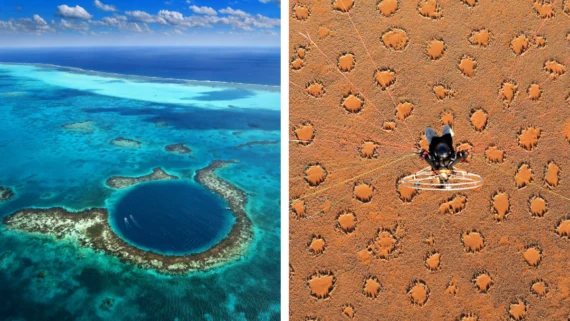
This massive underwater sinkhole is a giant circle of deep blue water surrounded by shallow turquoise reefs. It was originally a limestone cave system formed during the last ice age when sea levels were much lower. When the ocean rose, the caves collapsed, creating a vertical tunnel that is over 400 feet deep and 1,000 feet wide. Divers flock here to see the giant stalactites that still hang deep underwater, marking a time when this oceanic abyss was actually dry land.
14. Mount Roraima – Venezuela

Known as a tepui or tabletop mountain, Roraima is a massive plateau that sits 9,000 feet in the air and is often surrounded by a sea of clouds. Because it has been isolated from the forest floor for millions of years, the top of the mountain has its own unique flora and fauna. Many of the plants found here are carnivorous, and some of the animal species exist nowhere else on Earth. It was the original inspiration for Sir Arthur Conan Doyle’s The Lost World, and looking at its sheer cliffs, it’s easy to see why.
15. The underwater city of Yonaguni – Japan

Off the coast of Yonaguni Island, divers discovered massive, stepped stone structures that look like a sunken pyramid or a grand stadium. Some archaeologists believe these are the ruins of a 10,000-year-old civilization that was submerged by rising sea levels. Others argue that the monument is a natural geological formation created by the unique way the sandstone fractures. The debate continues to rage, but the sight of these sharp, 90-degree angles underwater is undeniably breathtaking.
16. The fairy circles of Namibia

Across the Namib Desert, there are millions of circular patches of bare red earth surrounded by rings of grass. For decades, scientists debated whether they were caused by radioactive soil, toxic plants, or even UFOs. The current leading theories are a battle between sand termites and self-organizing plants competing for water, but neither explanation fits every circle perfectly. These mysterious patterns create a polka-dot landscape that stretches for hundreds of miles, and nobody knows for sure who the gardener is.
17. The devil’s kettle – USA

In Minnesota’s Judge C.R. Magney State Park, a waterfall splits in two; one half flows into the lake, while the other disappears into a deep hole in the rock. For years, people threw logs, ping-pong balls, and even GPS trackers into the kettle to see where they would come out, but nothing ever reappeared. Recently, hydrologists used dye to prove that the water eventually flows back into the river, but the exact path it takes through the underground rock remains a secret. It’s a literal disappearing act that has stumped locals and tourists for generations.
18. The plain of jars – Laos

The Xiangkhoang Plateau is home to thousands of massive stone jars, some weighing up to six tons, scattered across the landscape. Archaeologists believe they were used as part of ancient burial rituals over 2,000 years ago, but how they were moved and carved with such precision remains a mystery. The area is also one of the most heavily bombed places on Earth from the Vietnam War, making excavation dangerous and difficult. These silent stone giants sit as a haunting reminder of a culture that left behind a massive puzzle.
19. The petrifying well – UK

Located in North Yorkshire, this well was once feared to be cursed because anything placed under its dripping water (from hats to teddy bears) would eventually turn to stone. Today, we know the water has a very high mineral content that creates a hard crust over objects, much like how stalactites form in caves. However, the speed of the process is what baffles scientists, as it can petrify a small stuffed animal in just a few months. It remains a popular magical spot where tourists leave items to be transformed by the water’s mineral touch.
20. The sea of stars – Maldives

At night, the beaches of Vaadhoo Island glow with a brilliant, electric-blue light that looks like a mirror of the stars above. This stunning bioluminescence is caused by millions of tiny plankton called dinoflagellates that emit light when they are disturbed by the waves. While the biology is understood, the sheer scale and intensity of the glow in the Maldives are unmatched anywhere else in the world. It is a natural light show that feels like stepping into a dream, proving that the ocean still has plenty of magic left to show us.
Explore more fascinating places:
Stumbling upon these strange places serves as a humbling reminder that even in our modern world, the Earth still guards many of its deepest mysteries. Whether it is fire burning behind a waterfall or stones that move across a desert on their own, these locations invite us to keep asking questions and stay curious about the unknown. If you enjoyed these scientific puzzles, don’t miss these 18 Strange Places on Earth That Break the Laws of Physics, or 17 Wild Photos Depicting Nature Taking Over Abandoned Places. You can also enjoy these 15 Cursed Places That Explorers Avoided Throughout History.