Since its launch in 1990, the Hubble Space Telescope has completely changed the way humanity sees the universe. Orbiting high above Earth’s atmosphere, the Hubble has captured breathtaking images of distant galaxies, planets, and stars with a level of clarity that was once impossible. Beyond the stunning visuals, the telescope has also helped scientists answer major questions about the age, expansion, and structure of the universe itself.
The photos and facts we’ve gathered here highlight both the scientific importance and cultural impact of the Hubble Telescope over the decades. Some images reveal deep space in extraordinary detail, while others showcase the technology that kept the telescope operating far longer than originally expected. Together, they tell the story of one of the most influential scientific inventions ever created. Let’s take a look at 15 photos and facts about the Hubble Telescope.
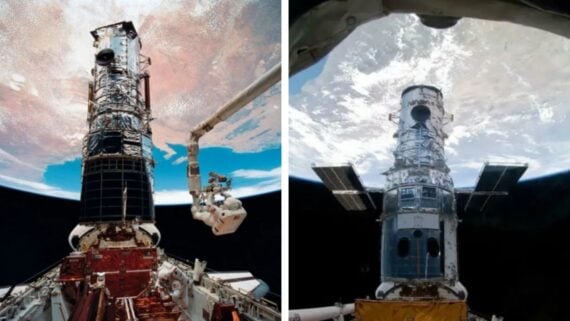
1. This photo is from the first repair mission for the Hubble Telescope in 1993

Did you know that the Hubble Telescope has had five service missions since its launch? These missions are to help the telescope reach the apex of its scientific capability.
2. Edwin Hubble, posing inside the 200-inch Hale Telescope, 1953

Hubble conducted research at the Palomar Observatory, where the Hale Telescope (also known as the Palomar Telescope) was created. Edwin Hubble was the first astronomer to use this telescope, right before he passed in 1953.
3. The Hubble Space Telescope returns to orbit as an improved telescope after its second servicing mission in February 1997

The Hubble Telescope cost roughly $16 billion to create. This price includes all servicing costs, but not ongoing operations.
4. The launch of Space Shuttle Discovery, 1984

The Hubble Space Telescope was launched on April 24th, 1990, aboard the Space Shuttle Discovery, which had itself been launched on August 30th, 1984. This monumental event marked the beginning of a new era in space exploration.
5. The Hubble Space Telescope is massive

The fully developed telescope is about 43.5 feet wide and 14 feet in diameter. Its massive size is to ensure it’s large enough to accommodate its many instruments and cameras. The weight of the telescope is 24,500 pounds, but this doesn’t matter in space, where there is no gravity to weigh it down.
Trending on The Scroller
6. The Hubble moves incredibly fast

The Hubble Telescope travels 17,000 mph around the Earth. That means it completes an orbit in just 95 minutes, offering continuous real-time data. Its speed ensures it can cover large areas of the sky, providing astronomers with a wealth of information.
7. The first image from the Hubble Telescope, May 1990

The initial image was blurry due to a flaw in the Hubble’s mirror, but despite this, it was still an important milestone that marked the beginning of the Hubble’s journey.
8. The most recent photo taken of Eta Carinae, March 26, 2025
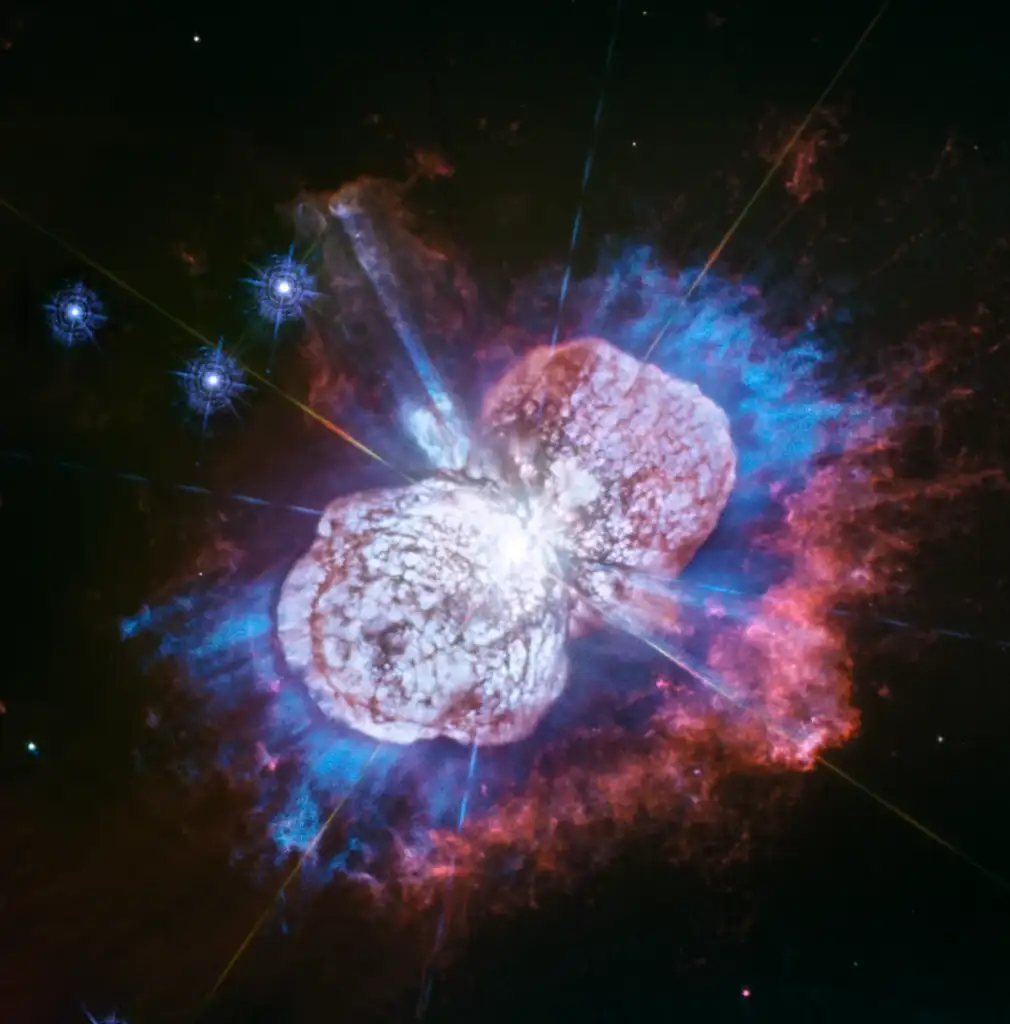
This is the most recent photo taken by the Hubble telescope of Eta Carinae. Eta Carinae is one of the most massive binary star systems known, and it’s located approximately 7,500 light-years from Earth.
Sign up for our newsletter
9. A young Edwin Hubble at Mount Wilson’s 100-inch telescope in 1922

Edwin Hubble made several groundbreaking discoveries using the Mount Wilson Observatory’s telescope. He revealed that the universe is far larger than the Milky Way and, most importantly, that it’s expanding. These findings fundamentally changed our understanding of the cosmos.
10. Inspecting the telescope’s primary mirror, late ’70s

Did you know the mirror’s perimeter was too smooth, so they had to send up another piece three years after it was launched to correct it? This is what caused the first few photos from the Hubble Telescope to appear blurry.
11. The most iconic photo taken by the Hubble Telescope

This is a photo of the “Pillars of Creation”. The stunning shot was taken in 1995 and shows huge columns of gas and dust where new stars are being born. Amazingly, this telescope offers us a glimpse into the process of star formation.
12. The Hubble Telescope helped discover dark energy

The Hubble’s observations of distant supernovae played a massive role in the discovery of dark energy. Dark energy is the mysterious driving force for the accelerated expansion of the universe.
13. The Hubble’s orbital altitude will shock you

The Hubble Space Telescope’s orbital altitude is just above the Earth’s atmosphere at approximately 320 miles high. This unique position allows it to capture sharp, clear images of distant stars and galaxies, free from distortion caused by the atmosphere.
14. The James Webb Space Telescope is considered a successor to the Hubble

The James Webb Space Telescope (JWST) launched on December 25, 2021, and is the most powerful space telescope ever built. It is designed to observe the universe in infrared light, allowing us to look deeper in space than Hubble. The JWST has revealed galaxies that formed just a few hundred million years after the Big Bang.
15. Refinement of the Hubble Constant

The Hubble Space Telescope’s observations helped refine the Hubble Constant, which describes the rate at which the universe is expanding. This constant plays a critical role in determining the age and size of our universe, offering valuable information about our future.
Want to see more space content?
Check out 20 Photos from the Space Race Era (1955-1975), or take a look at 15 Rare Photos of the 1960s Space Race Obsession in Every American Home. Finally, if you want to see photos of the moon landing, check out 20 Photos From The 1969 Moon Landing.