Walking into a typical living room in the 1990s felt like stepping into a sanctuary of physical media and clunky hardware. Back then, our homes were filled with specific items designed to perform a single task, from playing music on a shiny disc to rewinding a rented movie before taking it back to the store. We lived in a world of cords, cassettes, and bulky plastic storage solutions that felt permanent at the time. It’s hard to believe that in just a few decades, almost everything we considered a “household staple” has been condensed into a single device that fits in our pockets.
The disappearance of these items wasn’t just about fashion; it was an evolutionary shift in how we consume information and entertainment. Many of these objects vanished because the technology they relied on became obsolete almost overnight once high-speed internet and streaming took over. While we definitely don’t miss the tangled wires or the constant need for AA batteries, there is a deep sense of nostalgia attached to the tactile nature of these ’90s relics. Let’s take a trip down memory lane and look at eighteen things that defined our domestic lives before the digital age took over.
1. CD towers and racks

In the 90s, your music collection wasn’t just a playlist; it was a physical monument in your living room. These tall, plastic or wooden towers were designed to display dozens of CD jewel cases, serving as both storage and a conversation starter for guests. An interesting fact is that these racks actually became a design nightmare for many because the hinges on the jewel cases were notoriously fragile and constantly snapped. Once MP3s and iPods arrived, these bulky towers went from “essential decor” to “garage sale clutter” almost instantly.
2. Physical encyclopedias

Long before Wikipedia, a shelf full of leather-bound encyclopedias was the ultimate symbol of a “smart” household. These massive sets of books were often sold door-to-door and cost families thousands of dollars to keep updated every year. Interestingly, the Encyclopaedia Britannica finally stopped its print production in 2012 after 244 years because it simply couldn’t compete with the instant updates of the internet. Today, these beautiful but heavy books are mostly used as hollowed-out “secret safes” or decorative shelf fillers in vintage-themed bars.
3. Transparent landlines phones

Nothing screamed “90s teenager” more than a corded landline phone with a completely see-through plastic casing. These phones allowed you to see the colorful wires, circuit boards, and the actual mechanical bell that rang when someone called. They were part of a larger design trend called “Clear Tech” that influenced everything from Game Boys to pagers during the mid-to-late 90s. As mobile phones became affordable and cords became a nuisance, these neon-wired relics were relegated to the back of the junk drawer forever.
4. VCR head cleaners

Because VCRs used physical magnetic tape, the “heads” inside the machine would frequently get dirty, causing the picture to look snowy or distorted. Everyone owned a special cleaning cassette that you would douse with a tiny bottle of isopropyl alcohol before “playing” it for thirty seconds. It was a stressful ritual because if you used too much liquid, you risked ruining your expensive VCR permanently. With the transition to DVDs and then digital files, the need for a physical “cleaning tape” vanished along with the satisfying click-clack of a VHS tape loading.
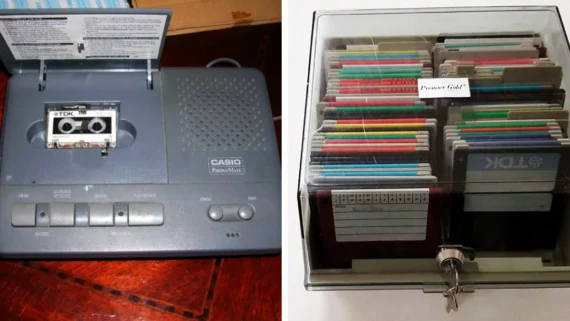
5. Floppy disk storage boxes

If you owned a computer in the 90s, you likely had a gray or beige plastic box with a “lock” on the front to protect your precious 3.5-inch floppy disks. These disks only held about 1.44 MB of data, which is less than a single high-quality photo taken on a modern phone today. A fun fact about these boxes is that they were often designed to be stackable, creating miniature “filing cabinets” for your primitive word documents and games. Once USB flash drives and cloud storage took over, these plastic bins were abandoned, leaving the “save” icon as the only living memory of the floppy disk.
Trending on The Scroller

6. The Yellow Pages

Before Google, this massive, heavy book of yellow paper was the only way to find a plumber or a pizza place in your town. It was so thick that many families used it as an improvised “booster seat” for children to reach the dining table. An interesting fact is that at its peak, millions of copies were printed every year, consuming an astronomical amount of paper before digitalization made them obsolete. Today, receiving one on your doorstep feels more like a recycling chore than a useful resource.
7. Portable CD players

The Discman was the pinnacle of music technology in the 90s, allowing you to take your favorite albums everywhere, provided you didn’t walk too fast. The biggest problem was that any sudden movement made the music “skip,” so expensive models included a 10-second “anti-shock memory” feature. It was a fashion accessory in its own right, even though it took up your entire pocket and ate through AA batteries like candy. With the arrival of the iPod and MP3s, these circular devices went from being the future to museum pieces in the blink of an eye.
8. Pagers or beepers

Before mobile phones were common, the “pager” was the ultimate tool for being reachable, even though you could only receive phone numbers or short numeric codes. 90s teenagers even invented a “code language” (like 143 for “I love you”) to communicate through the tiny liquid crystal screens. Interestingly, despite appearing as primitive tech, they are still used in some hospitals today because of their reliability in areas without mobile coverage. However, in the average home, they disappeared the moment the first Nokia made its appearance.
Sign up for our newsletter
9. The desktop Rolodex

If you worked in an office or had many contacts, the Rolodex was your physical database, filled with white cards with names and addresses scribbled on them. Spinning the wheel to find a contact had a very satisfying mechanical sound that no smartphone has managed to replicate yet. Often, the cards were full of personal notes, coffee stains, and crossed-out numbers, becoming a messy diary of your professional network. It was replaced by Outlook and Google contacts, leaving these vintage objects as simple desk decorations for retro lovers.
10. Cassette tape adapters for cars

This ingenious gadget allowed older cars with cassette players to play music from a CD player or even early MP3 players. It consisted of a fake cassette with a cable coming out of the side, a somewhat “clunky” but incredibly effective solution for its time. The cable often got tangled with the gear shift, and the sound quality depended entirely on how clean the car’s tape heads were. They vanished when car manufacturers finally started including auxiliary inputs and, later, Bluetooth as standard.
11. Handheld electronic organizers

Before Palm Pilots and smartphones, devices like the “Casio Digital Diary” were the dream of anyone who wanted to look organized and tech-savvy. They were basically glorified calculators with a tiny keyboard where you could store appointments and phone numbers in a very limited memory. Despite their futuristic look, typing on them was a slow and frustrating task that required a lot of patience. Today, any free calendar app does ten times more than these expensive little gadgets could ever dream of.
12. TV trays with folding legs

Dining in front of the TV in the 90s was a sacred ritual that required these individual wooden or plastic tables with metal “X” shaped legs. They were famous for being incredibly unstable; one wrong move could send your dinner directly onto the carpet. When not in use, they were stored in a vertical rack in a corner of the kitchen, gathering dust until the next movie night. The current trend of open spaces and larger coffee tables has caused these folding relics to disappear from most modern homes.
13. Slide carousels and projectors

Before we could project photos from our phones, family vacations were documented on 35mm slides that required a noisy projector and a white sheet on the wall. The sound of the fan and the metallic “click” as each image passed created a unique atmosphere that we now remember with nostalgia (or boredom). It was common for slides to get stuck or even melt if you left them too long under the projector’s powerful lamp. Now, those thousands of family images usually rest in boxes in the attic, waiting to be digitized.
14. Standalone answering machines

There was a time when the answering machine was a physical device with its own small cassette tape that blinked with a red light when you had new messages. Listening to messages out loud upon arriving home was a moment of drama or joy that the whole family shared (whether you wanted to or not). A fun detail is that many people recorded creative greeting messages with background music to impress whoever called. Today, voicemail is digital and integrated into the phone service, eliminating the need for this noisy and iconic plastic device.
15. CRT television sets

These televisions were as deep as they were wide and weighed so much that moving one required at least two people and a good physical therapist. They had a curved glass screen that attracted static dust almost magically and usually emitted a nearly imperceptible high-frequency hum. Most remembered is that when they were turned off, the image would condense into a small white dot in the center before disappearing completely. They were replaced by flat plasma and LED screens, freeing up square feet of space in living rooms worldwide.
16. Paper road maps in the glove box

Planning a trip in the 90s meant unfolding a giant map over the car hood and trying to fold it back correctly (something almost no one achieved). These maps usually lived in the glove compartment, worn at the edges and marked with a highlighter to point out the route. An interesting fact is that gas stations used to give them away or sell them for very little money as a way to attract customers. Today, GPS and Google Maps have turned the skill of “reading a map” into an almost forgotten art for the younger generations.
17. Fax machines in home offices

For a brief window of time, having a fax at home was the ultimate sign that you had a serious business or worked for a large corporation. The sound of dialing and the electronic screech as the thermal paper slowly emerged was the soundtrack to 90s productivity. The paper tended to curl and the ink faded over time, making important documents illegible after a few months. With the arrival of email and PDFs, the fax became a technological relic that today only survives in very specific sectors like legal or medical.
18. Clunky desktop scanners

If you wanted to digitize a photo in 1998, you needed a device the size of a small suitcase that took an eternity to “read” a single image. The process included a very distinctive stepper motor sound and a bright light that traveled slowly across the glass. They were expensive, noisy, and often had constant connection problems with the parallel ports of old computers. Currently, the camera on any smartphone has more resolution and speed than those gigantic peripherals that used to occupy half a desk.
In the mood for more nostalgia?
It is amazing to think that these items were once the height of convenience, only to be completely erased by the relentless march of technology. While our homes are certainly less cluttered today, we’ve lost a bit of that tactile, mechanical charm that made the 90s so unique. If you’re in the mood to keep exploring more nostalgic memories, don’t miss Inside the Blockbuster Weekend From the 90s-2000s, or these 21 Candid Photos From the 90s That Capture the Spirit of the Time. You can also check out these 20 Things Older Generations Did That Kids Today Won’t Get.