Then-and-now photos have a strange way of collapsing time. Decades that took millions of ordinary days to pass can suddenly fit inside a single frame, leaving two versions of the same place, person, or landscape staring back at each other.
Sometimes almost everything changes. Sometimes almost nothing does. And every so often, one stubborn detail survives while the entire world around it becomes unrecognizable. Put the images side by side, and time stops feeling gradual at all.
1. One House, 104 Years of Life
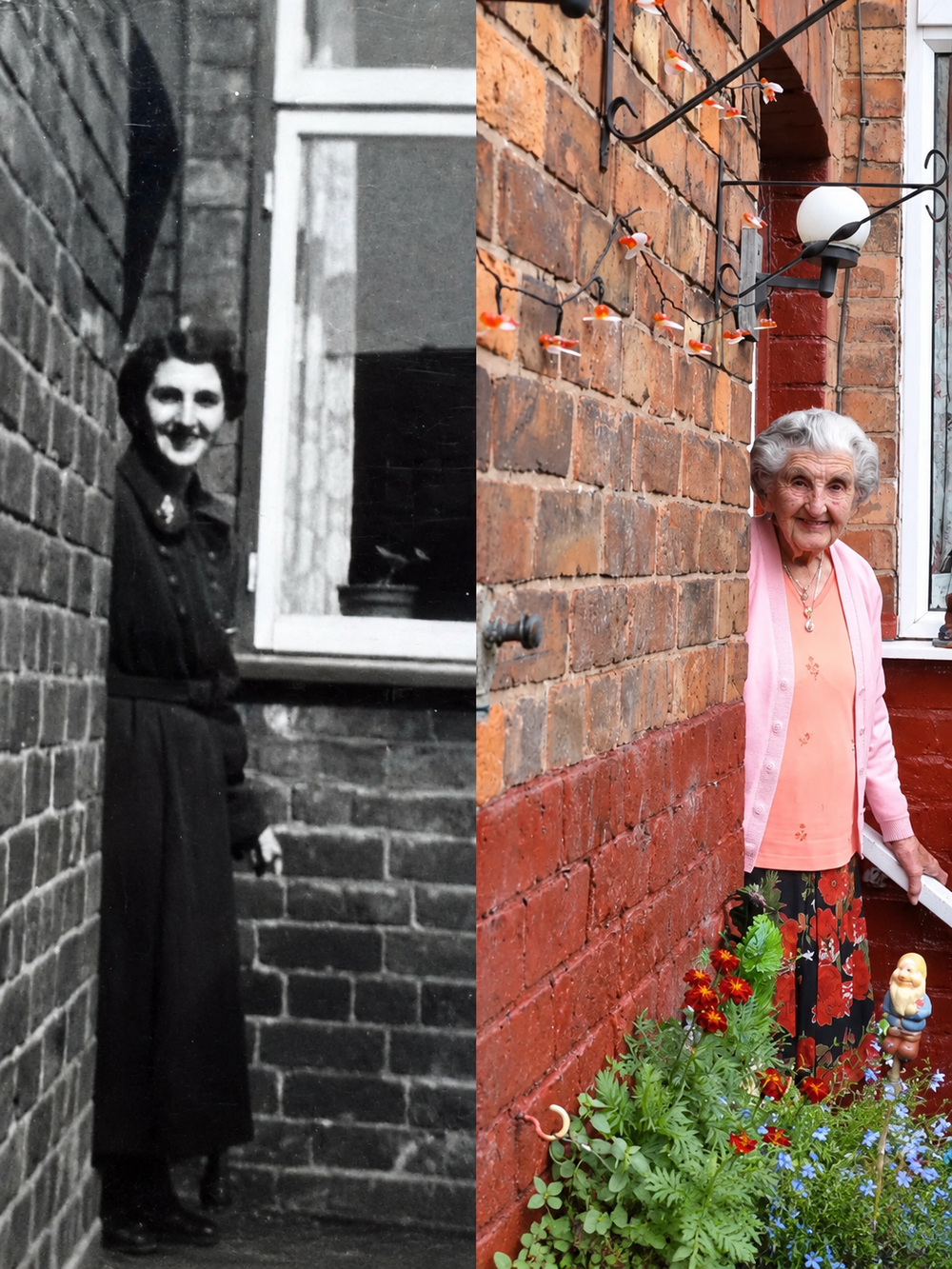
There is something almost impossible to grasp about spending more than a century connected to the same home. In the earlier photograph, a young woman stands beside the brick wall; generations later, an elderly woman appears in what looks like the same narrow passage. Buildings are usually the things that outlive us. What does it feel like when a person nearly keeps pace with one?
2. Los Angeles Before the Skyline Took Over
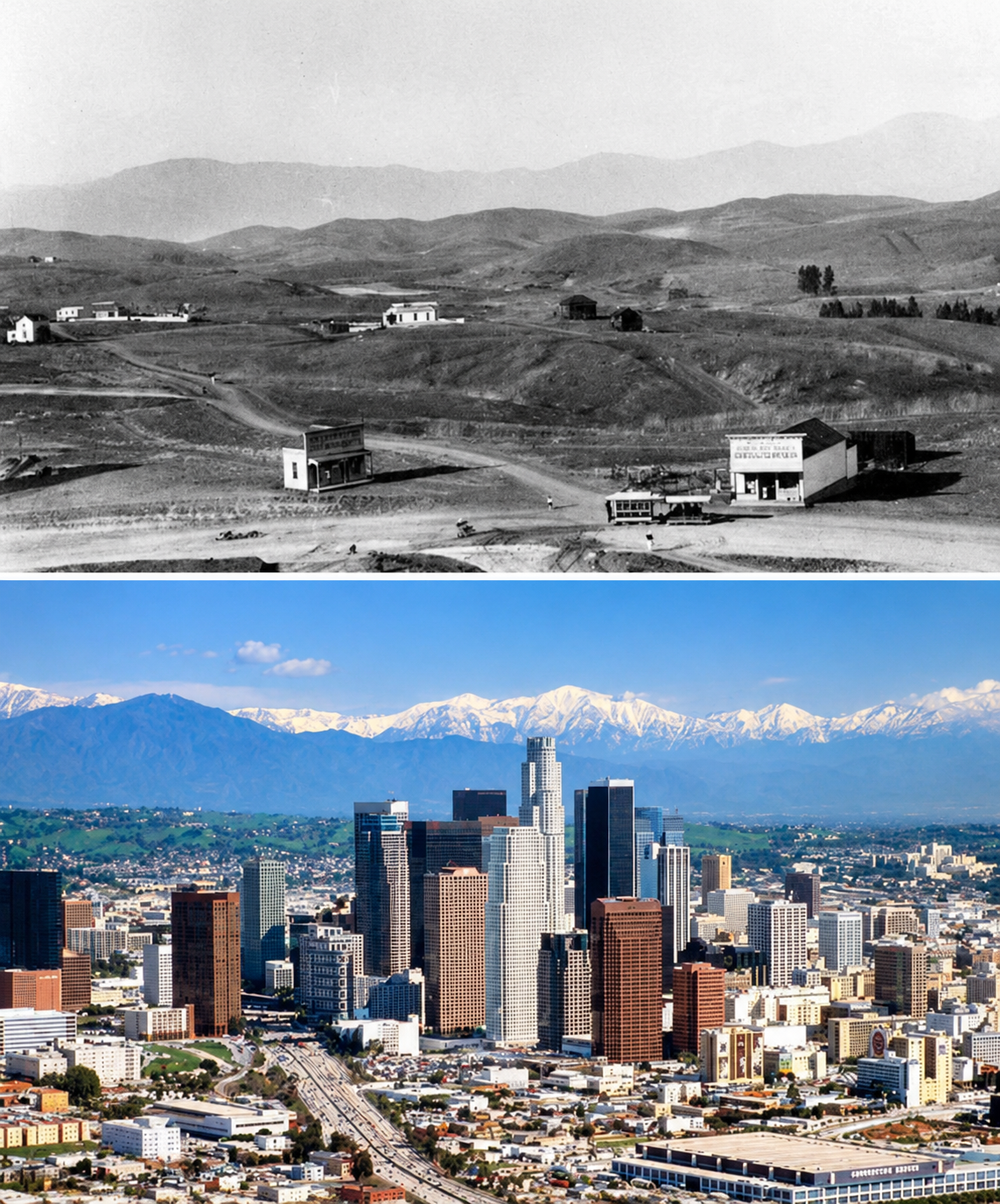
The earlier landscape is so open that it takes a moment to reconcile it with the dense city that followed. Roads, scattered buildings, and enormous stretches of undeveloped land eventually gave way to a skyline packed with towers and neighborhoods extending toward the mountains. Cities rarely announce the moment they become cities. They simply keep growing until the empty space is the part that looks unbelievable.
3. Uelzen, Germany: 1945 vs. 2021
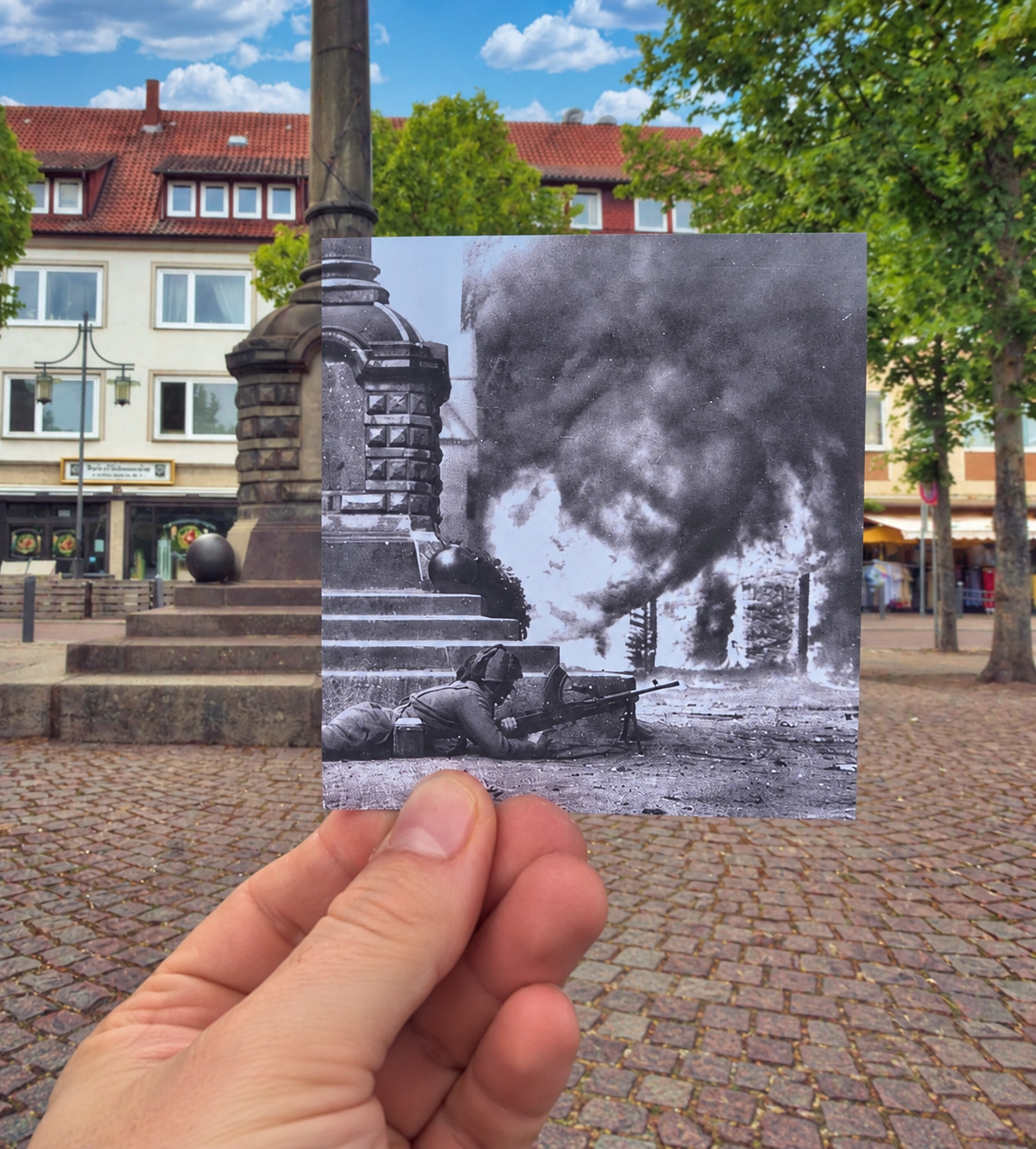
One location can hold two completely different realities. The wartime image captures a town square amid violence and destruction; decades later, the same physical space has returned to ordinary civic life. The monument helps connect the two scenes, almost like a pin holding separate chapters of history to the same piece of ground.
4. An Electronics Store, 1989 vs. 1998
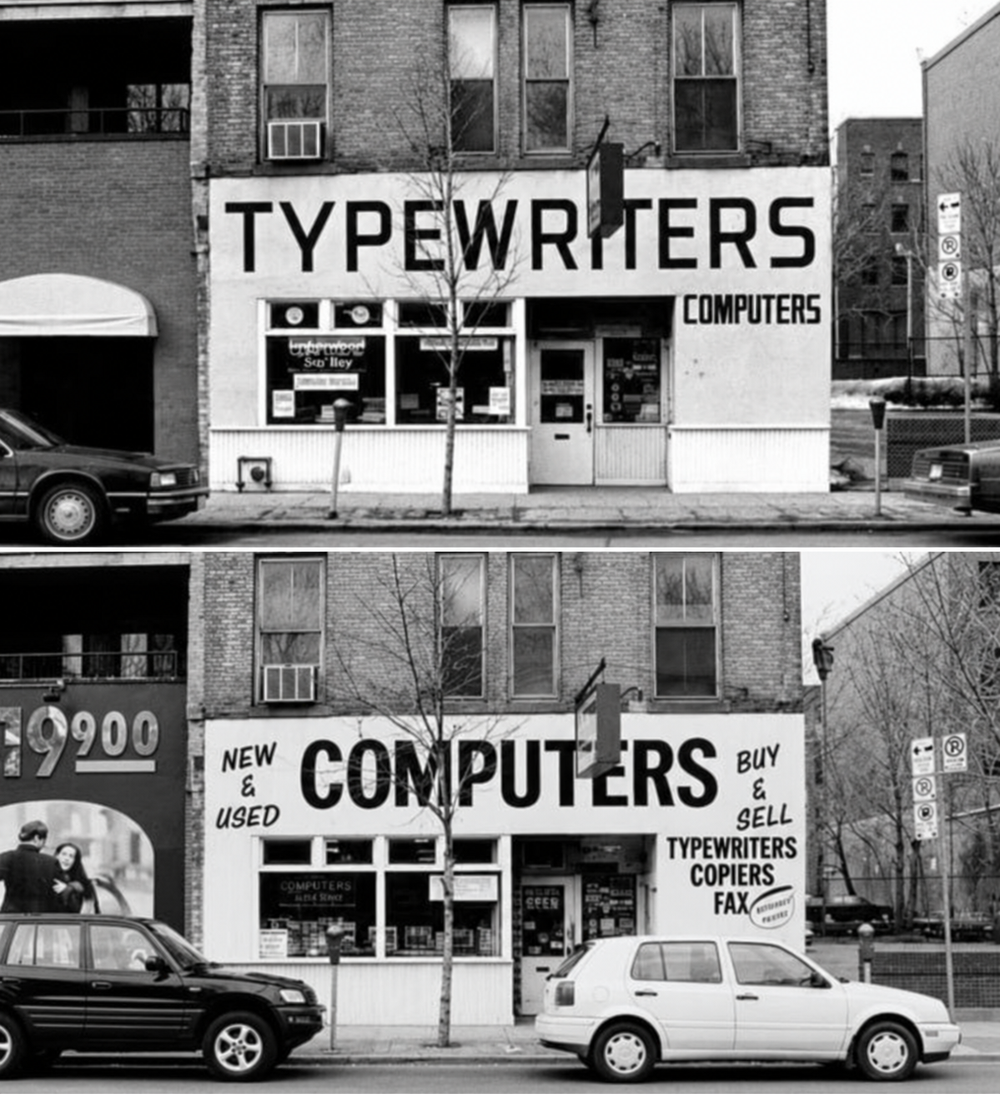
Nine years hardly sounds like enough time for a business to reinvent its identity, yet technology can make a decade behave like a century. The storefront moves from advertising typewriters to placing computers front and center, while typewriters are pushed into a smaller supporting role. How many objects surrounding us today are already quietly moving toward the edge of the sign?
5. The Flatiron Building, 1917 vs. 2012
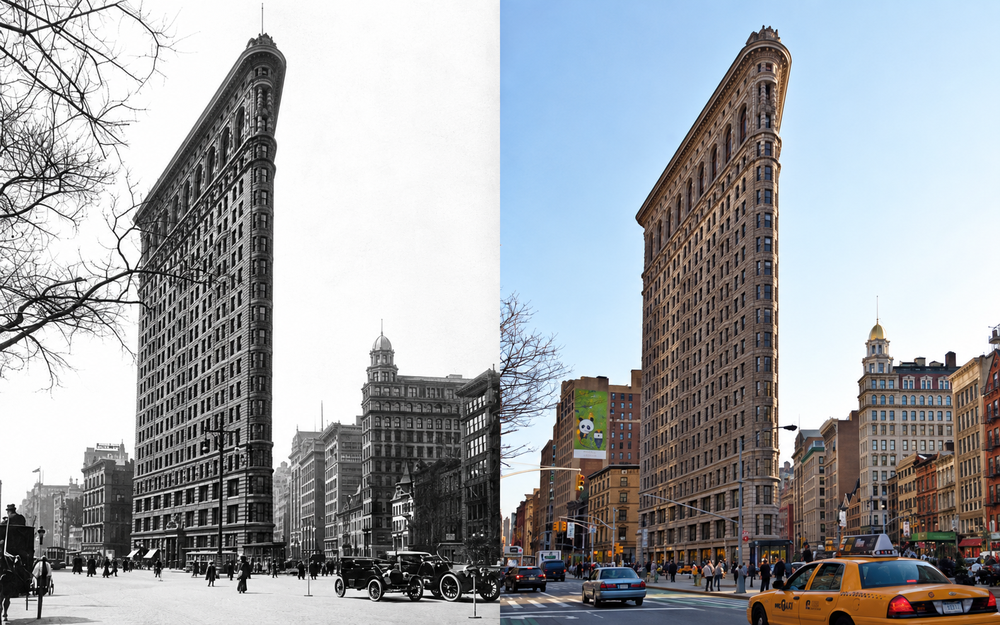
The astonishing part here isn’t what changed. It’s what refused to. Nearly a century separates the photographs, bringing different cars, streets, businesses, and rhythms of city life, while the Flatiron Building maintains its familiar wedge-shaped presence. Sometimes a landmark becomes a kind of visual anchor, allowing everything around it to reveal just how much time has passed.
Trending on The Scroller

6. Hong Kong’s Kowloon Peninsula, 1964 vs. 2016
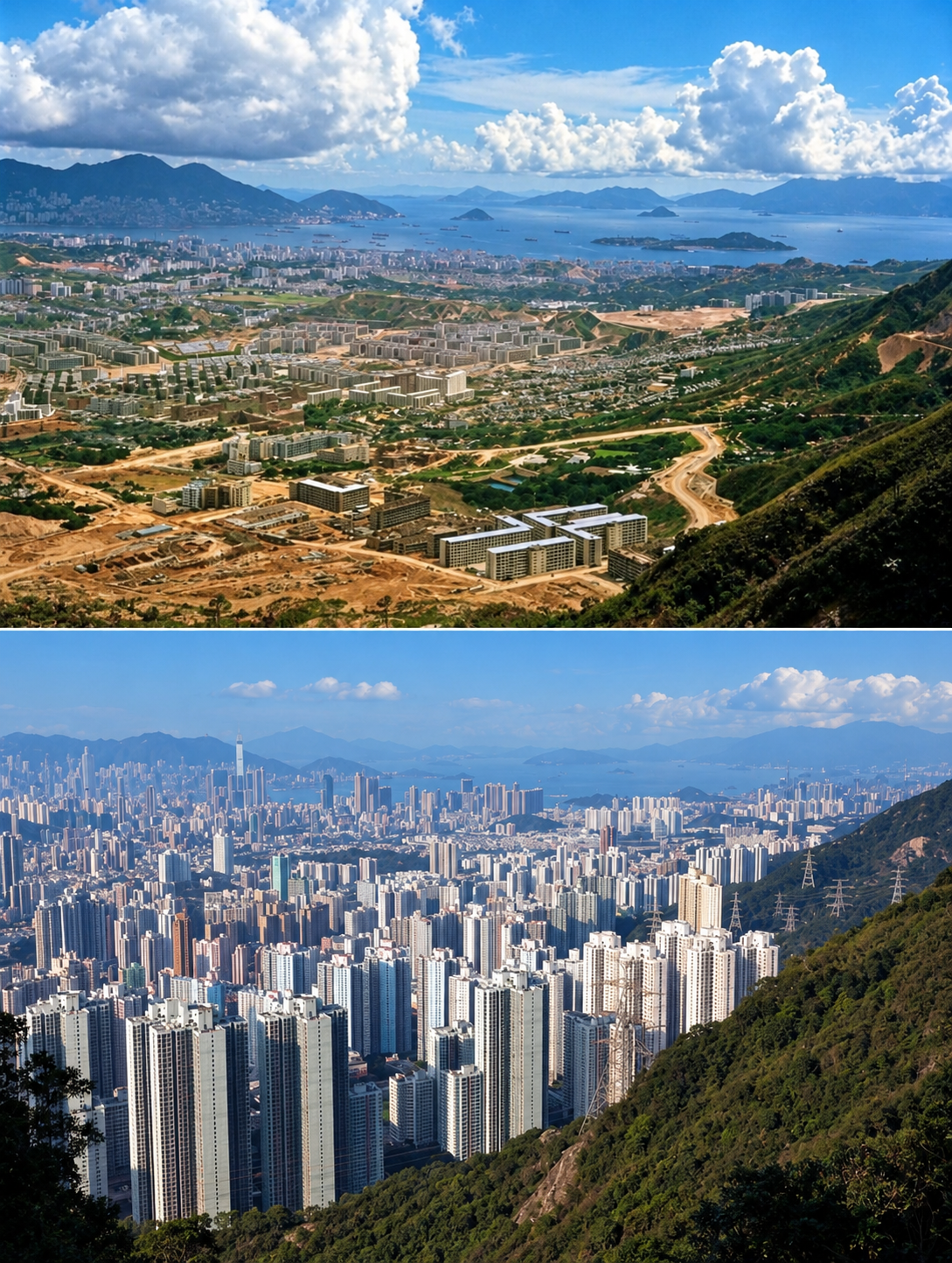
A few decades turned a relatively open urban landscape into an immense concentration of towers. The mountains and harbor still provide recognizable boundaries, but almost every available patch between them appears transformed by development. When geography limits where a city can expand, the answer eventually becomes visible in another direction: upward.
7. Main and Delaware Streets, Kansas City: 1906 vs. 2015
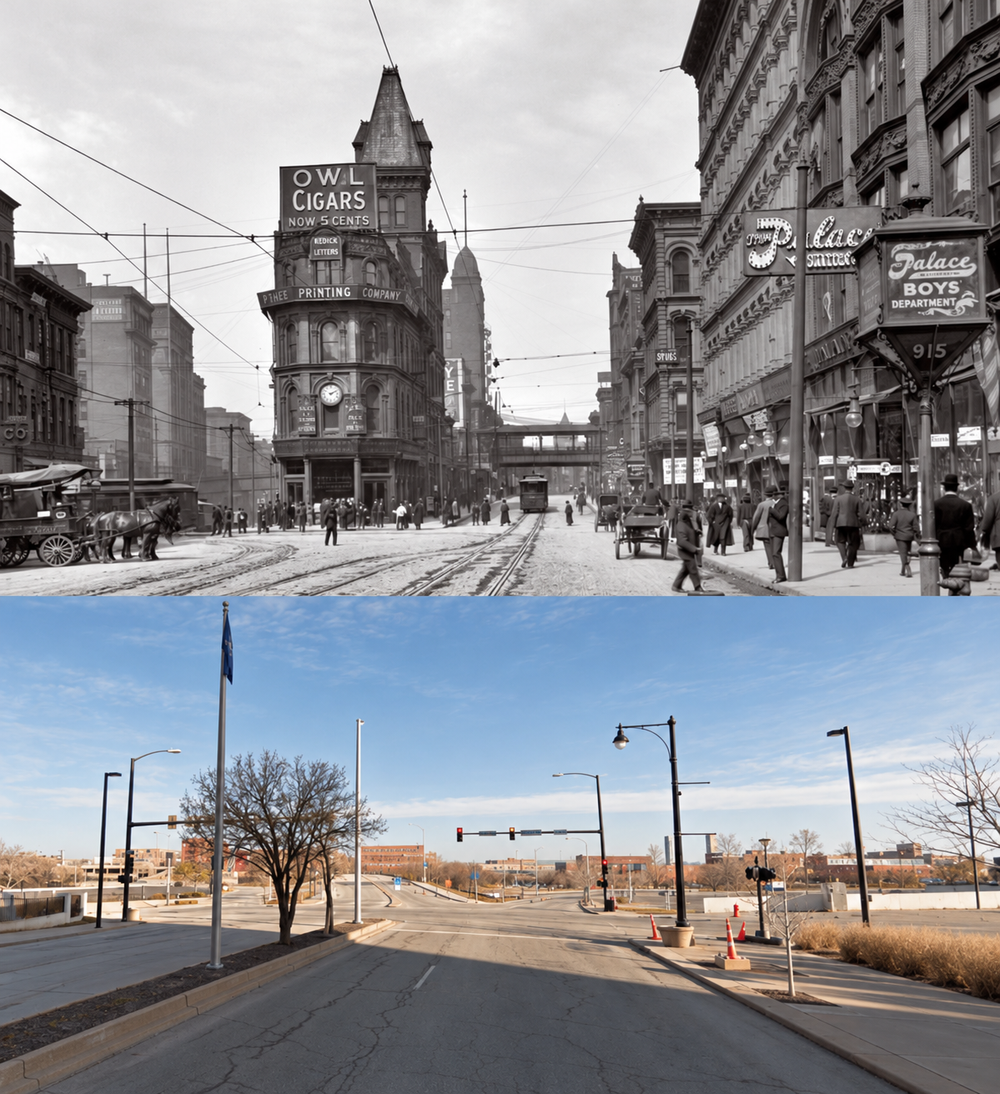
The earlier photograph is overflowing with urban life: pedestrians, storefronts, streetcars, overhead wires, horses, and buildings pressing against the road. More than a century later, the same location appears dramatically more open. Progress is often imagined as cities becoming denser and busier, but what happens when the historical photograph is actually the one that looks more intensely urban?
8. Prague, 1910 vs. 2020
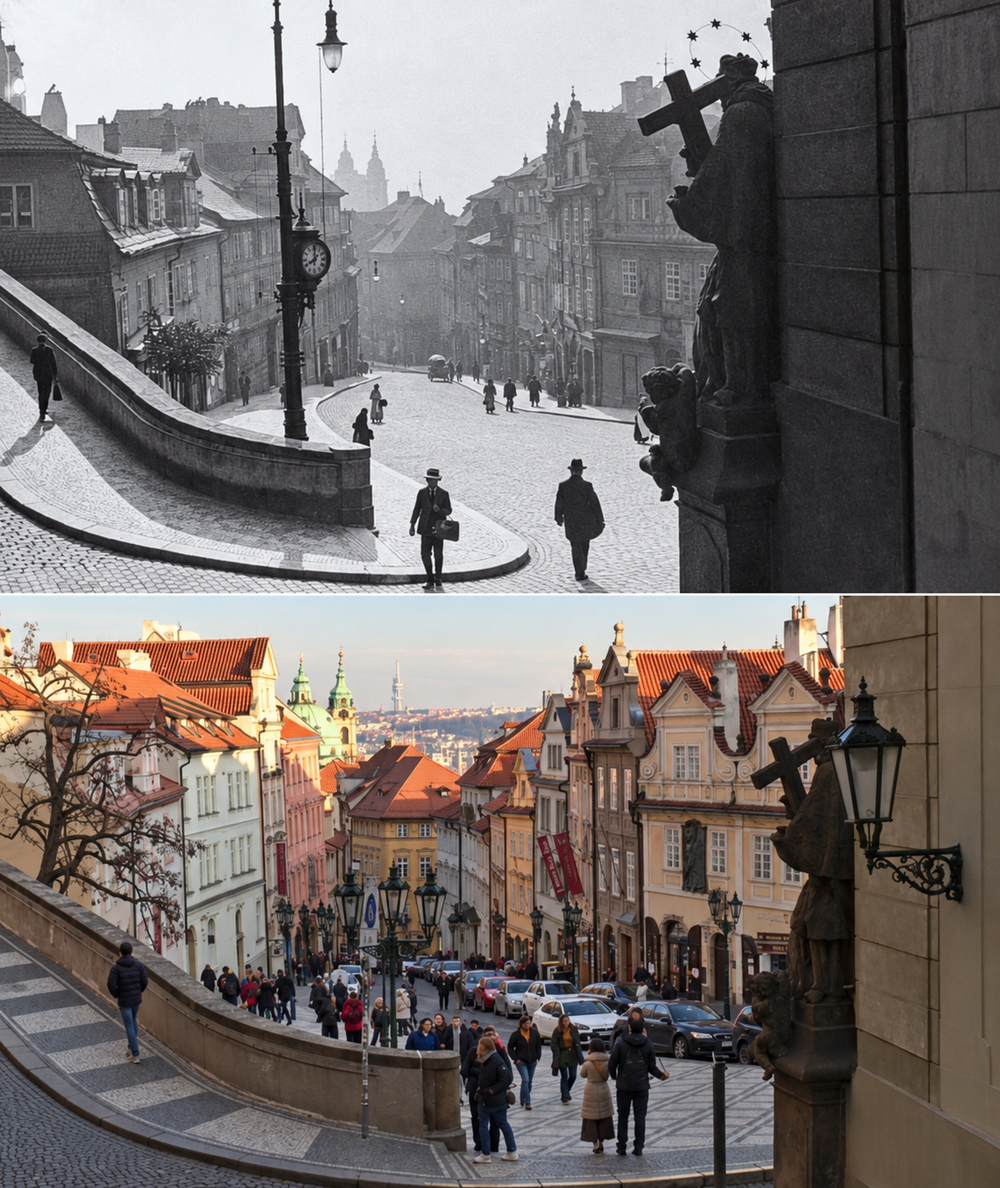
More than a century disappears surprisingly gently here. The street is busier, automobiles have arrived, and storefronts have changed, yet the architecture preserves enough of the earlier scene that the two eras seem almost capable of overlapping. Could someone standing there in 1910 have imagined that a visitor in 2020 would still recognize the same curve of the street?
Sign up for our newsletter
9. Visitors at the Metropolitan Museum of Art, 1910 vs. 2019
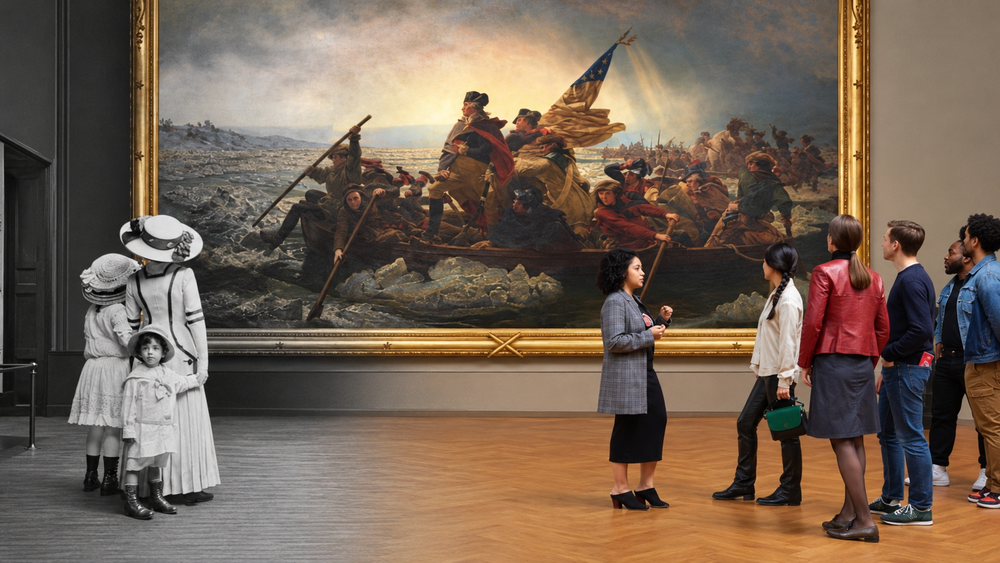
The artwork stays put while the audience changes around it. Clothing, posture, social customs, and the experience of visiting a museum belong unmistakably to different eras, yet people continue gathering in front of the same cultural objects. Museums preserve the past, but photographs like these reveal something subtler: eventually, the visitors become history too.
10. The Elbbrücke Bridge, Germany: 1959 vs. 2023
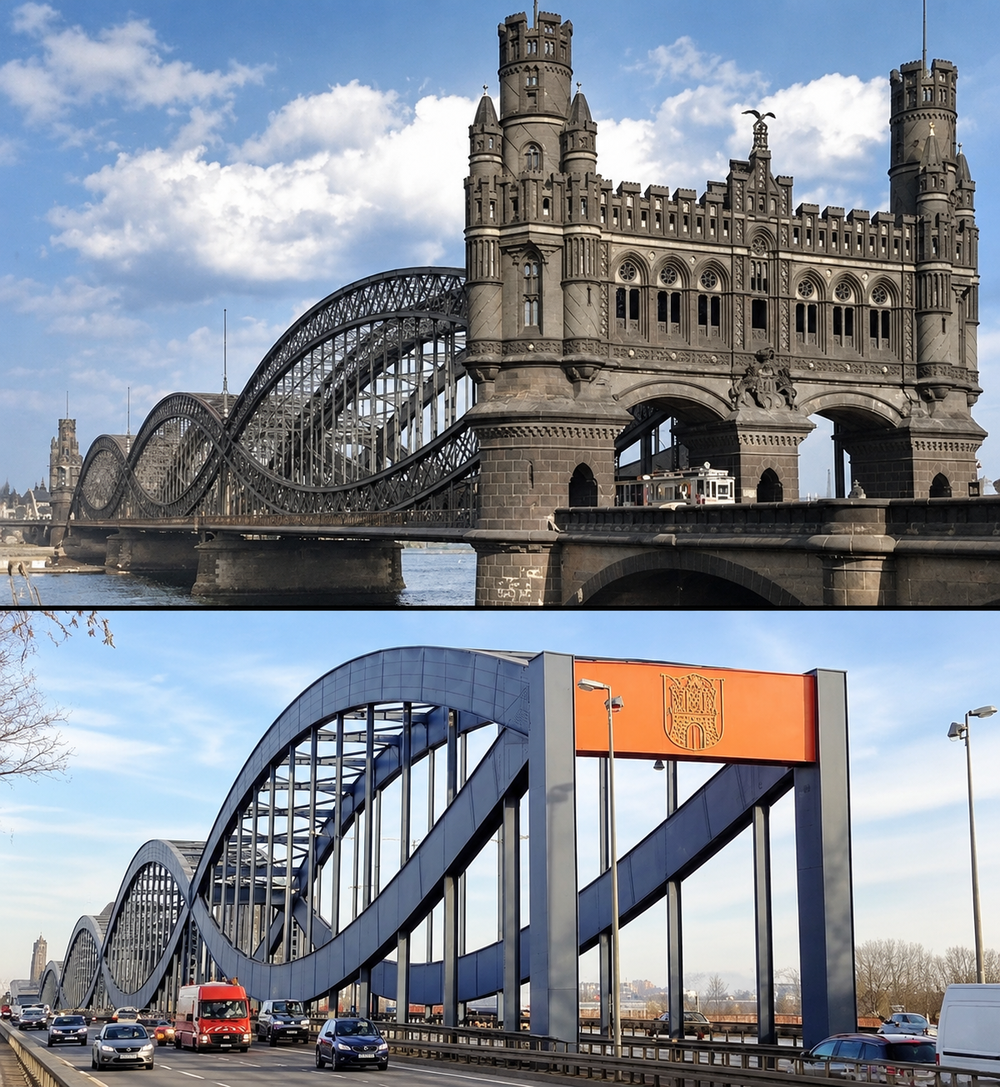
Then and now photos can make preservation look almost as dramatic as change. The elaborate older bridge structure and its modern successor occupy the same essential crossing, yet their architectural languages could hardly feel more different. One belongs visibly to another period; the other reduces the structure to cleaner industrial lines. Infrastructure may serve the same purpose for generations while completely changing the way an era chooses to express it.
11. The Pines in Fallsburg, New York: 1950s vs. Later Years

Few comparisons capture disappearance quite like a place once filled with people becoming silent. The earlier scene shows a crowded resort pool in full swing; the later image leaves recognizable pieces of the setting surrounded by vegetation and decay. The unsettling question isn’t simply where the people went. It’s how a place that once felt so permanent could become abandoned within living memory.
12. Two Generations Beside the Same WWII Hurricane
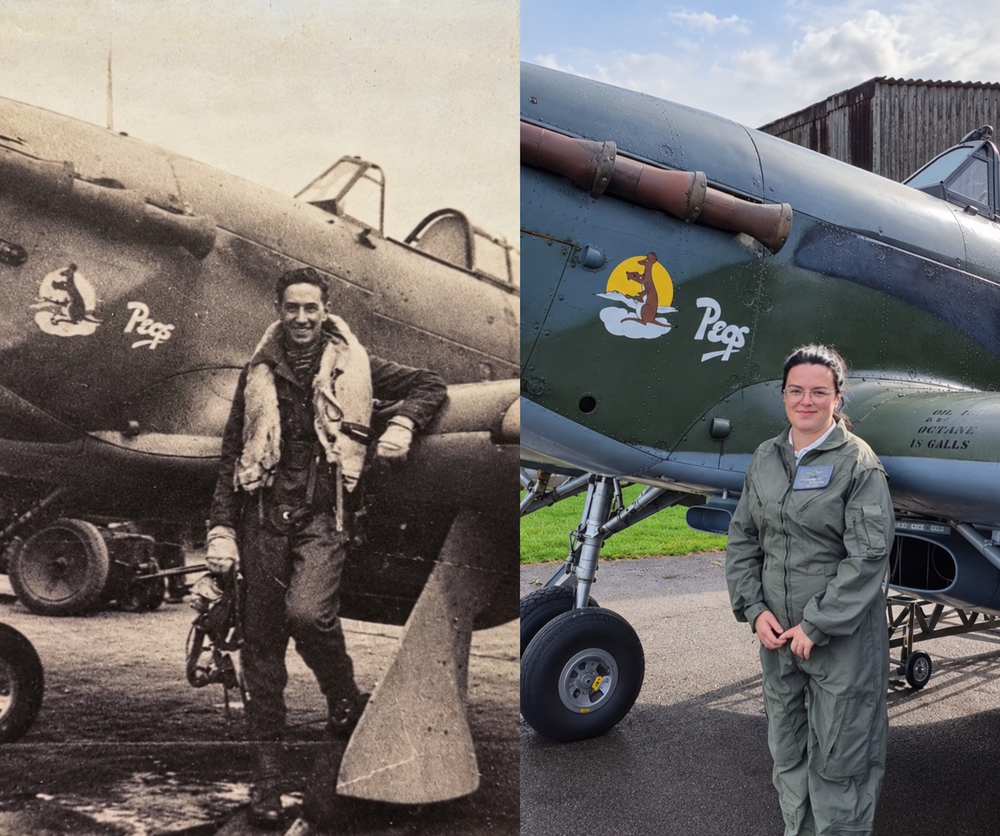
A wartime photograph and a later recreation connect family history through the same type of aircraft, turning military history into something unexpectedly personal. A granddaughter stands beside the Hurricane decades after her grandfather was photographed beside one during World War II. History is usually measured in dates and events, but sometimes the distance between eras is easier to understand when it can be measured in generations.
13. St. Martin Church in Cologne: 1946 vs. 2021
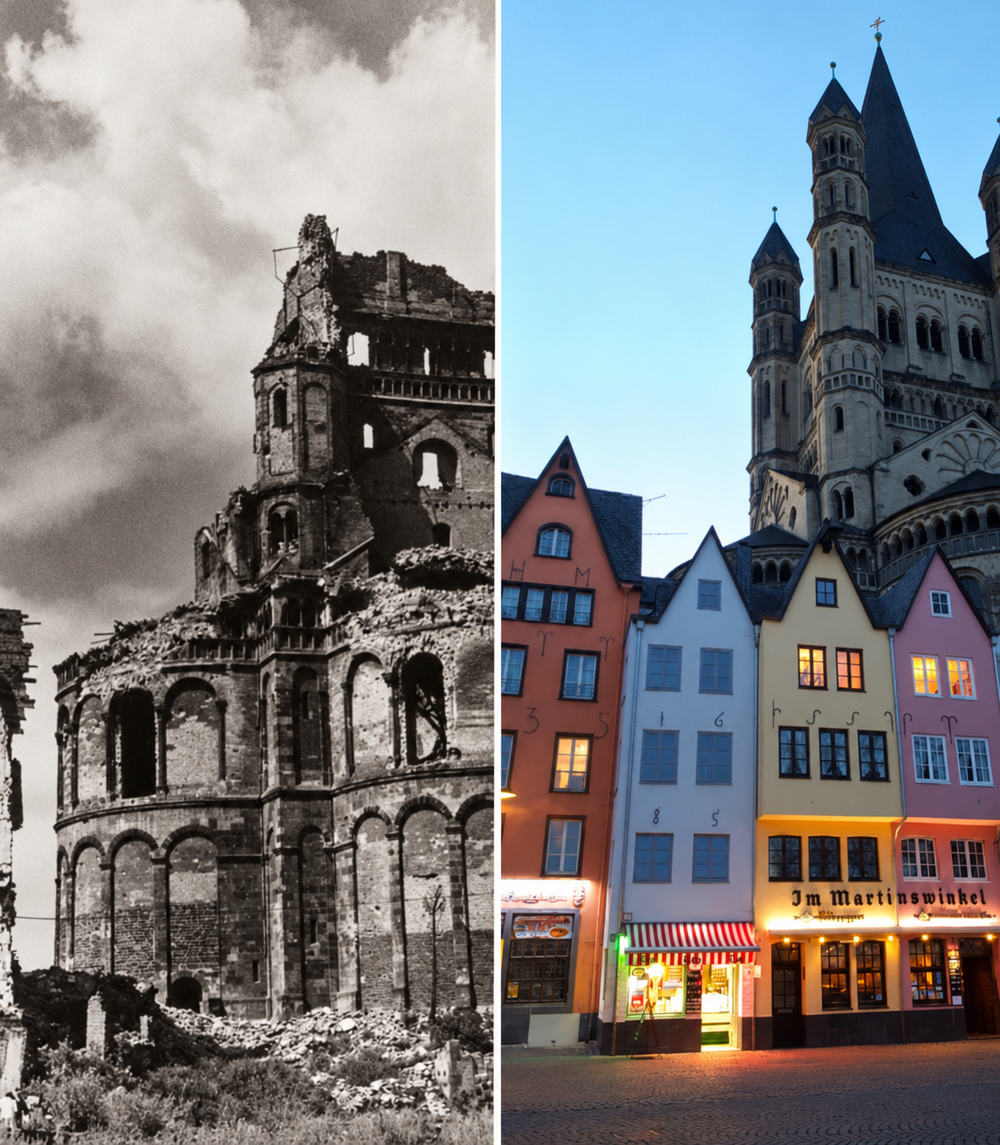
In the postwar image, the church stands heavily damaged amid the destruction left in Cologne. The later view presents a radically different scene: restored architecture rising above colorful buildings and everyday city life. How long does it take before a place associated with catastrophe becomes ordinary again? Reconstruction repairs stone and streets, but the photographs preserve the memory of what the restored city no longer shows.
14. The Tower of London, 1995 vs. Today
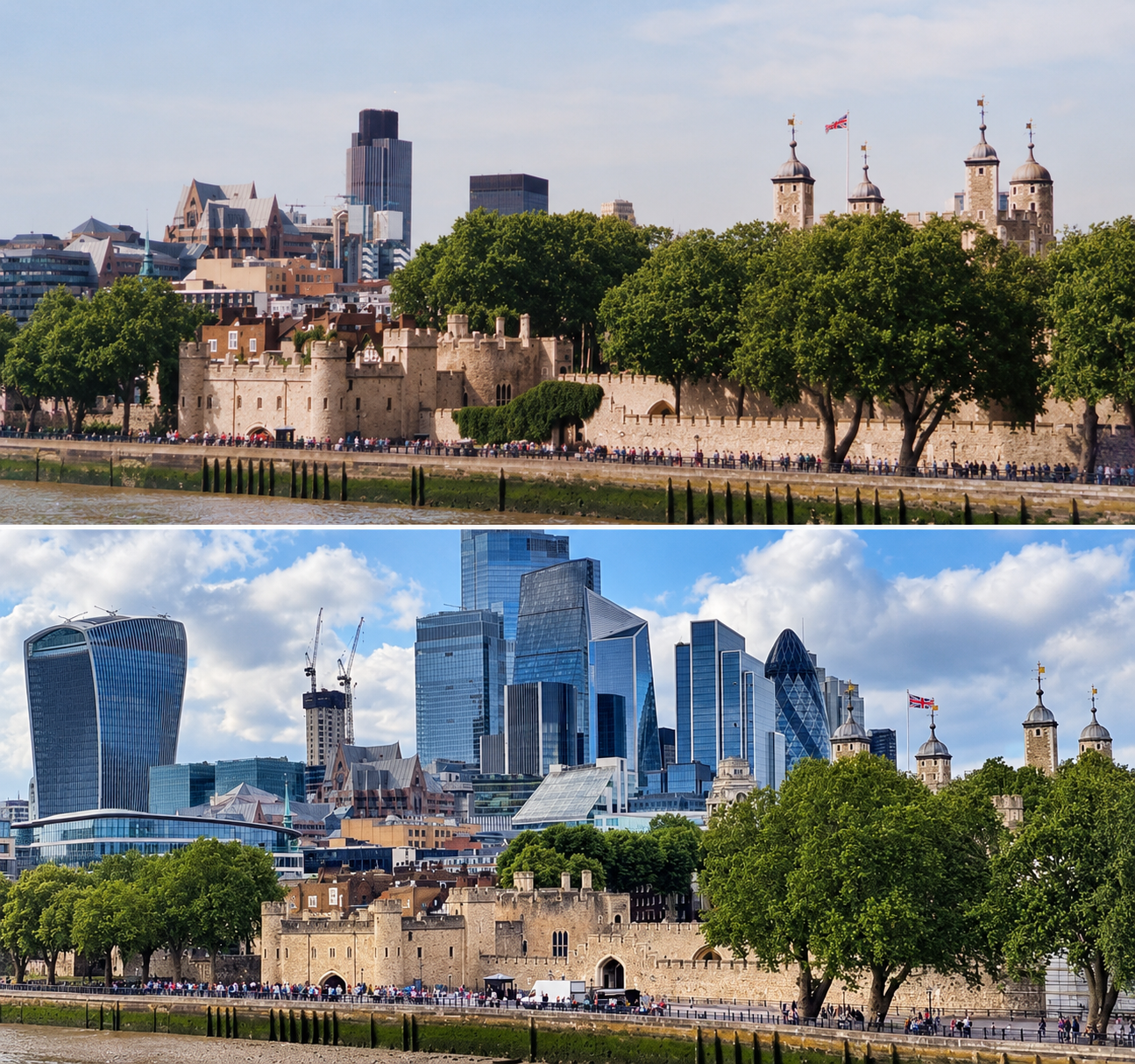
This comparison barely needs a century to feel dramatic. The Tower itself remains recognizable, but the skyline behind it changes from relatively modest development into a wall of modern high-rises. The effect is almost geological: centuries-old architecture in the foreground, a rapidly evolving financial district behind it, and two completely different speeds of history occupying the same view.
15. The Lincoln Memorial, 1922 vs. 2016
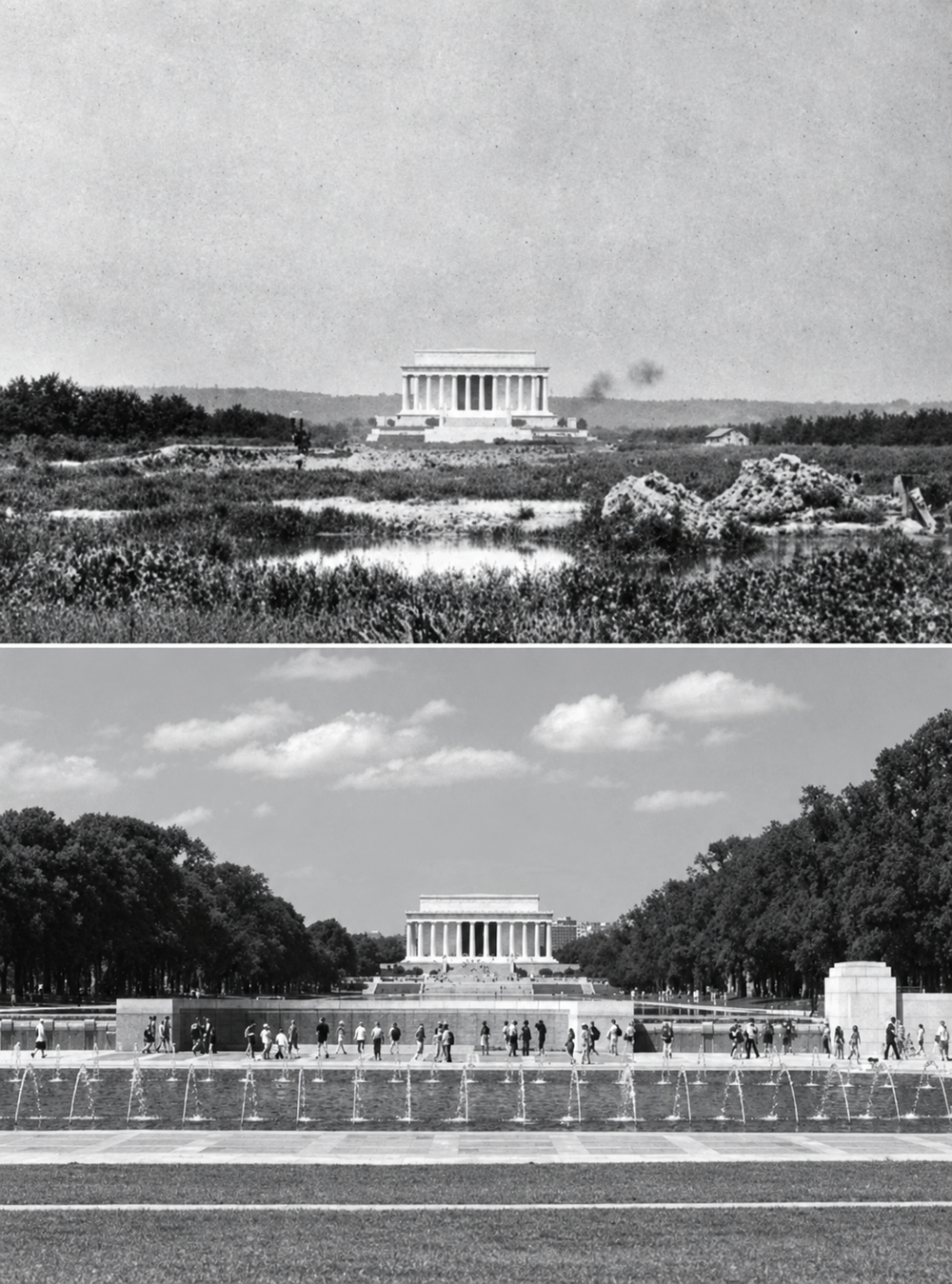
The monument is familiar in both photographs, but its surroundings tell the larger story. The earlier landscape around the newly completed memorial feels strikingly unfinished compared with the formal, tree-lined space recognized today. Iconic places can fool us into assuming they always looked inevitable. Then-and-now photography reminds us that even the most familiar national landscapes once had an awkward beginning.
16. Singapore, 2000 vs. 2023
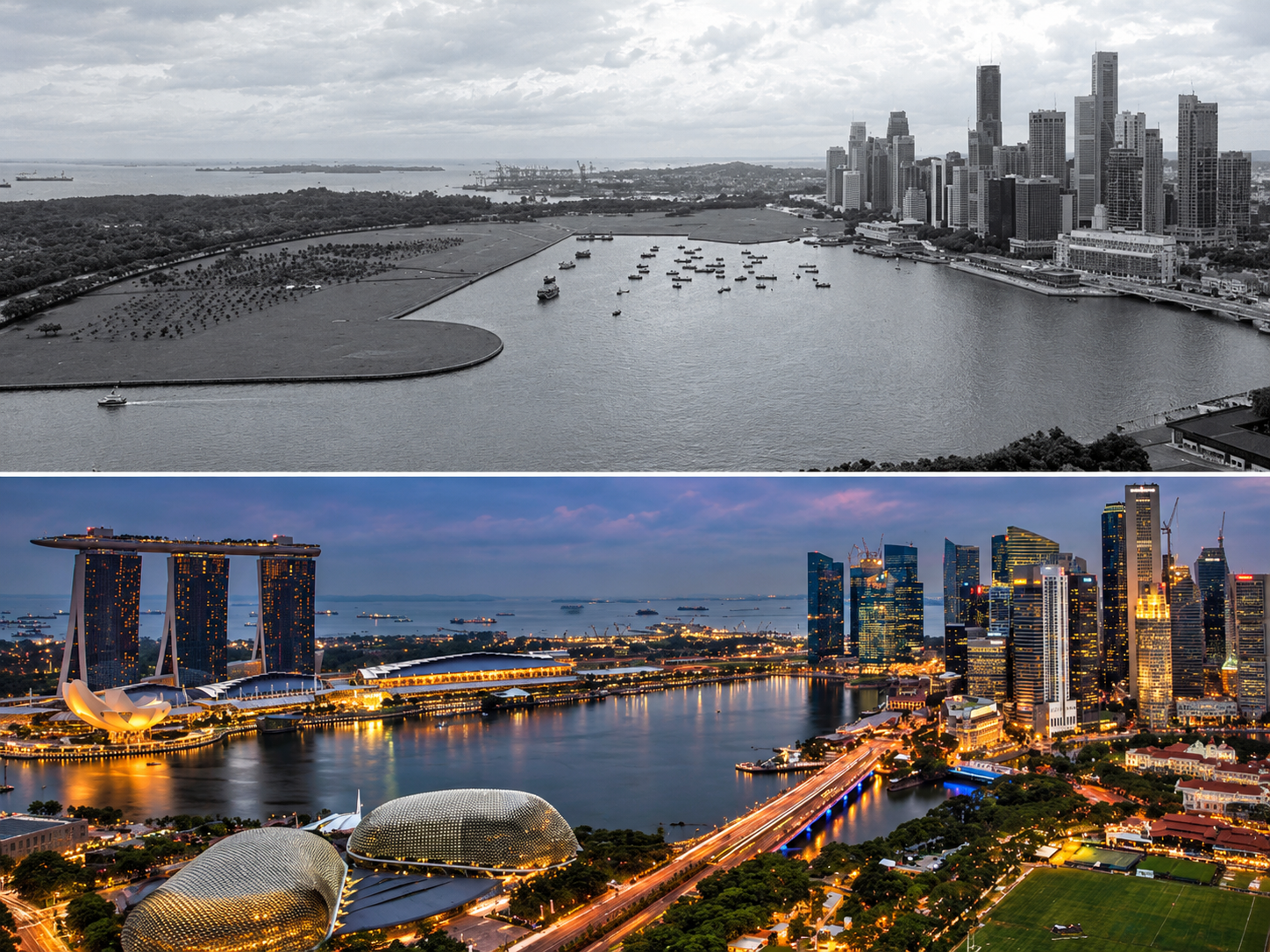
Twenty-three years can sound almost trivial beside comparisons spanning a century. Singapore makes those years look enormous. The waterfront transforms as major new architecture and development reshape the view, demonstrating how quickly a modern city can alter its silhouette. If this much can change in barely two decades, what will a photograph taken from the same spot reveal twenty years from now?
17. Hiroshima’s A-Bomb Dome: 1945 vs. Today
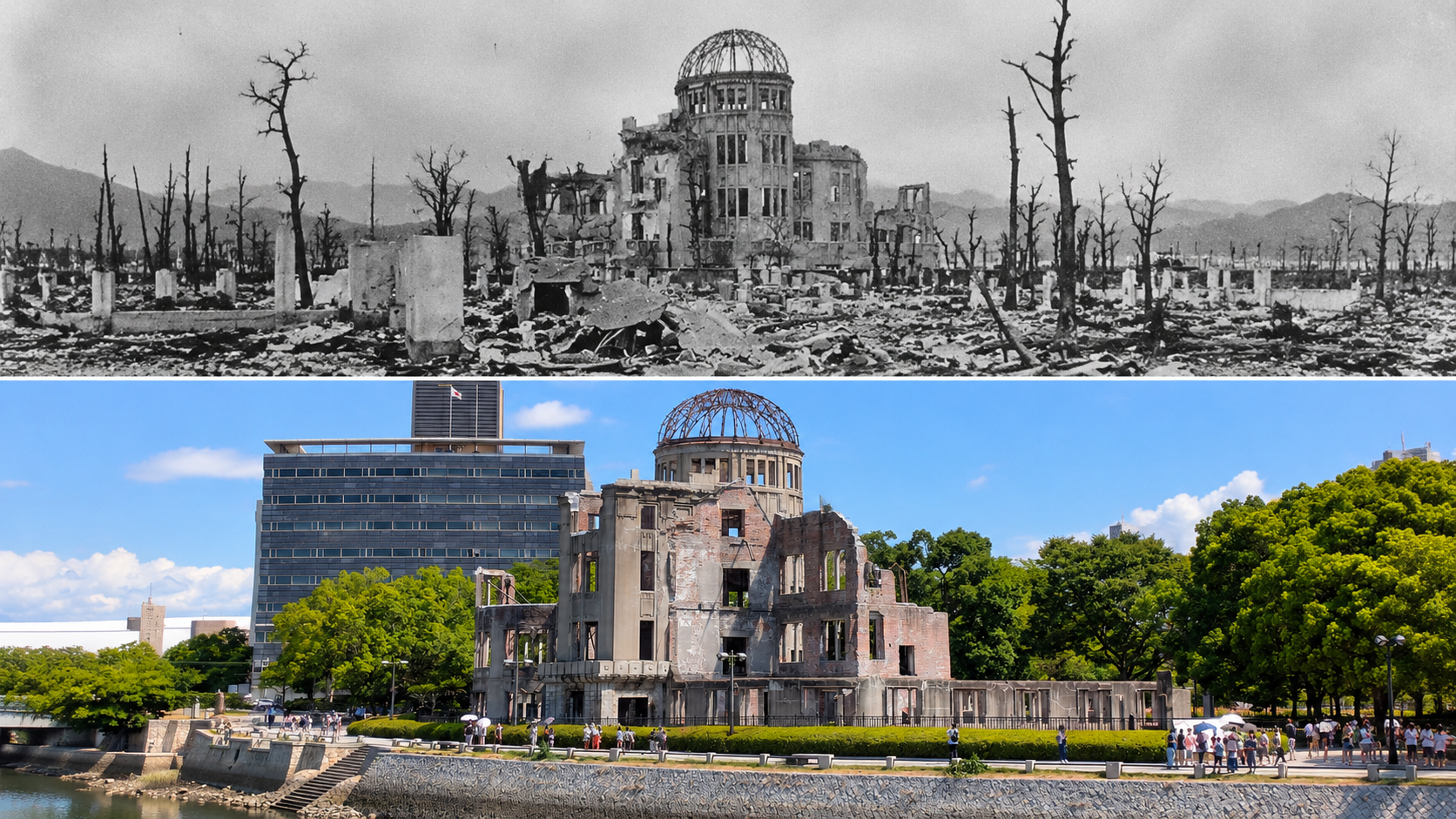
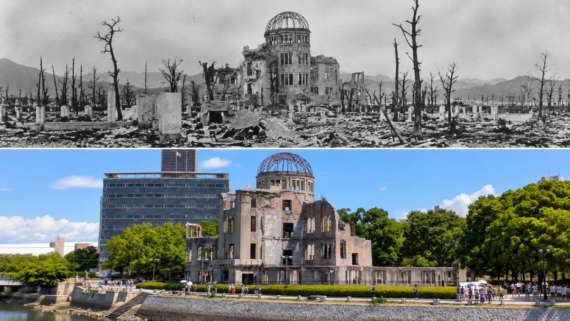
Few then-and-now comparisons carry this kind of weight. The structure now known as the A-Bomb Dome survived in ruined form after the atomic bombing of Hiroshima on August 6, 1945, and was preserved while the city surrounding it was rebuilt. The contrast is not simply between destruction and recovery. One ruin was deliberately allowed to remain, forcing the present-day city to coexist with a physical fragment of its most devastating day.
18. San Francisco After the 1906 Earthquake vs. Today
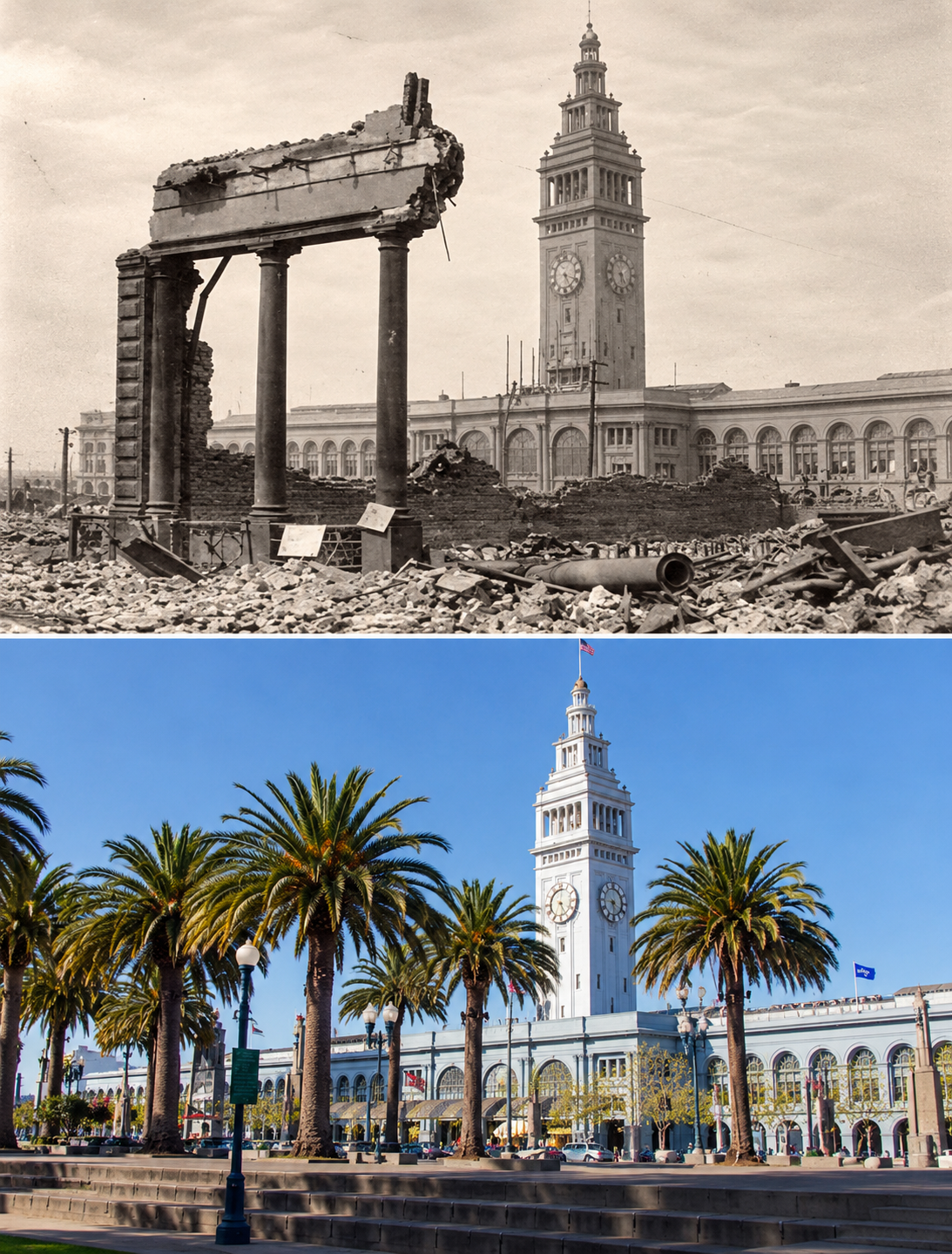
The 1906 earthquake and fires devastated large portions of San Francisco, making modern comparisons around surviving landmarks especially powerful. Around Market and Powell streets, recognizable architecture can provide a fixed point while more than a century of rebuilding unfolds around it. How many times can a city reinvent itself while still remaining unmistakably the same place?
19. The Reichstag and Berlin Wall: 1962 vs. Today
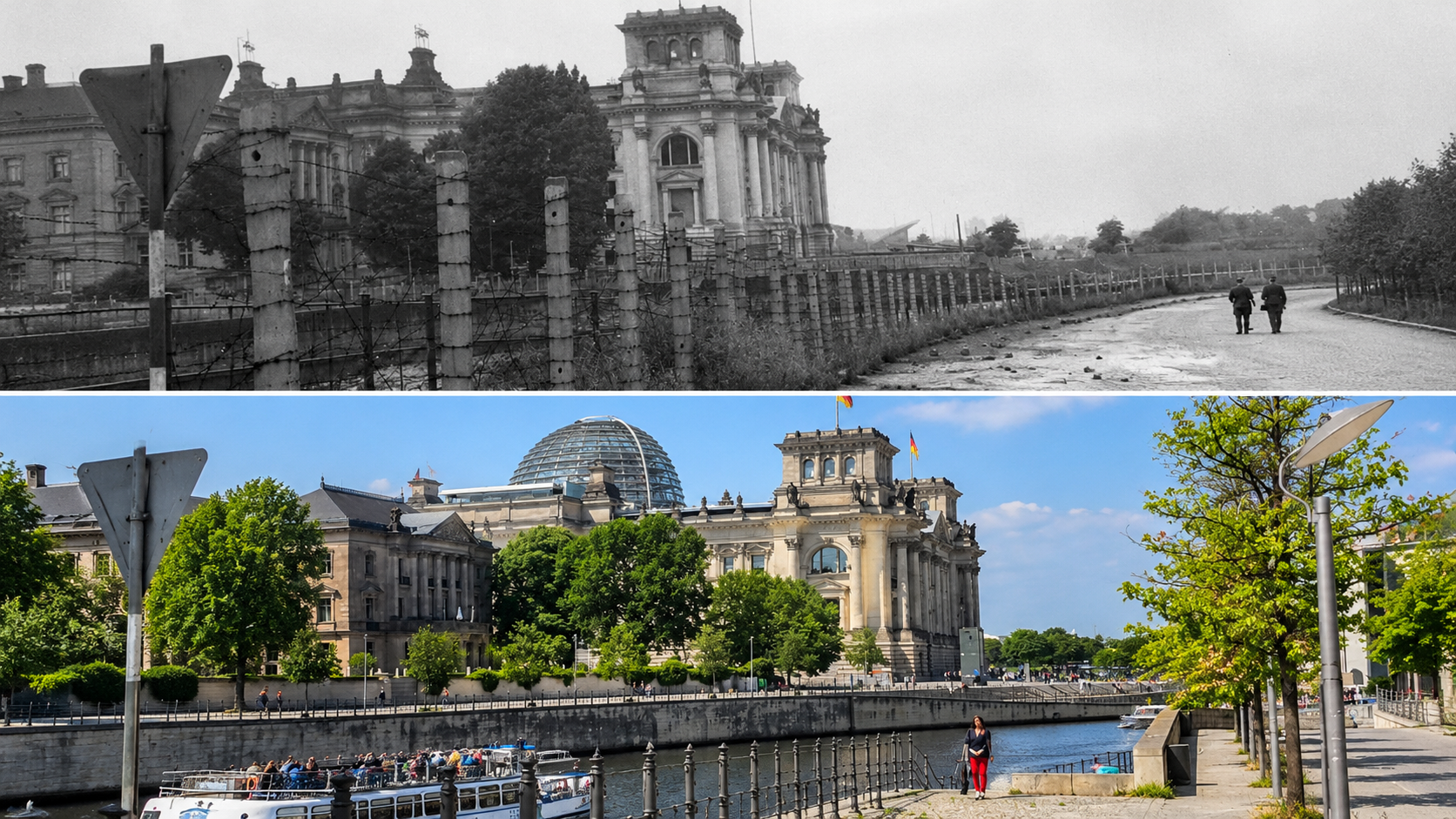
Here, what vanished matters more than what was built. A Cold War view around the Reichstag once included the Berlin Wall, turning the urban landscape itself into a political boundary. In a contemporary view after German reunification, that physical division is gone. Most then-and-now photographs document architecture changing. This one can document the disappearance of a border that once divided not just a city, but two political worlds.
20. London Bridge Skyline: 2005 vs. 2020
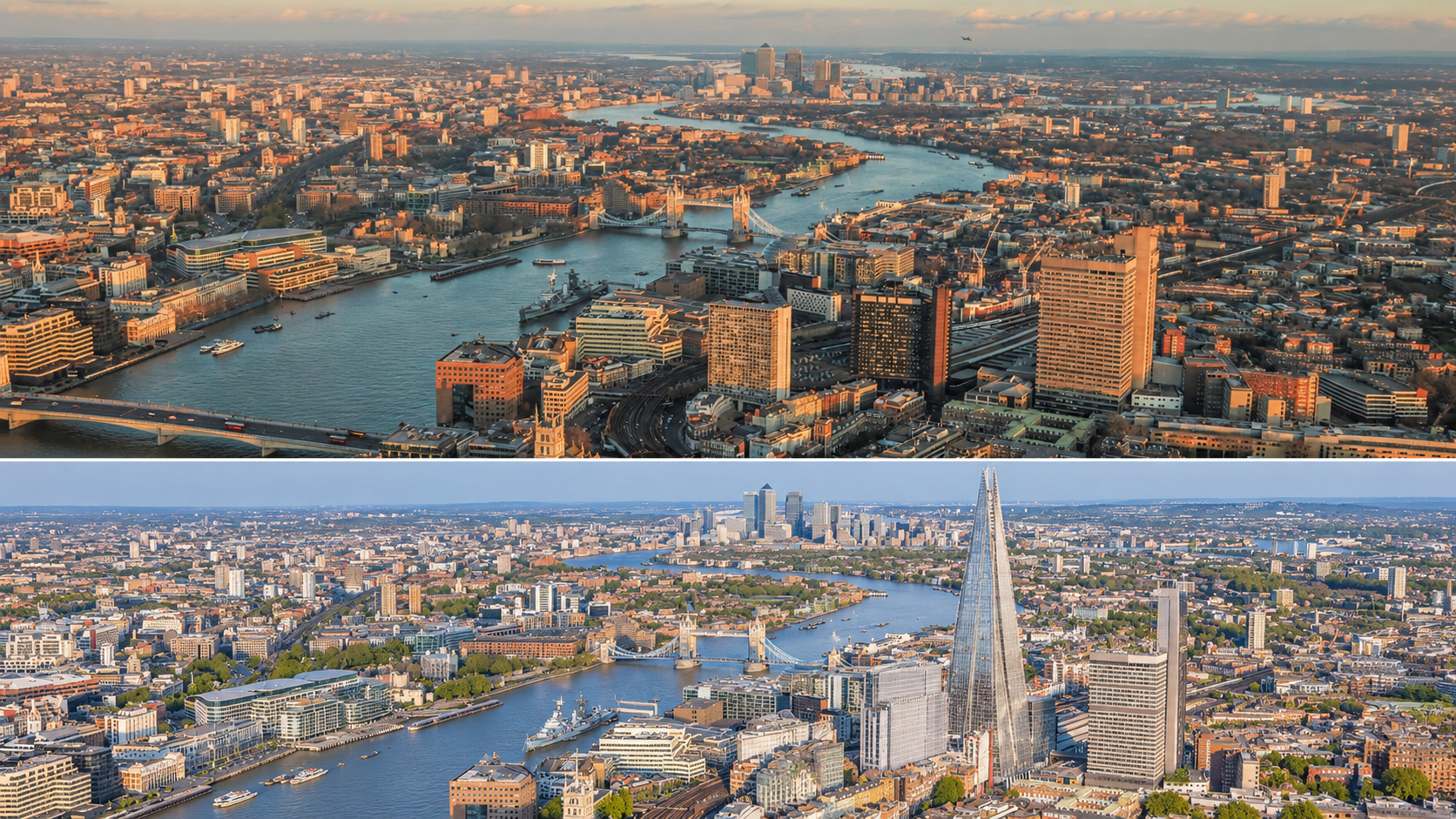
A mere 15 years can be enough to rewrite a skyline. Comparable aerial views of the London Bridge area capture the arrival of The Shard and surrounding high-rise development, replacing a lower skyline with one that feels unmistakably contemporary. Ending here reveals perhaps the strangest thing about these comparisons: history doesn’t always need a century. Sometimes it happens while we’re busy assuming everything still looks basically the same.
Looking across these photographs, time stops behaving as the slow, orderly thing calendars suggest. A city can rebuild after catastrophe, a skyline can rise within decades, a crowded resort can disappear into vegetation, and a single building can remain almost unchanged while generations pass around it. Maybe that’s what makes then-and-now photographs so absorbing: they show that the present isn’t permanent either. Somewhere, a completely ordinary photograph being taken today may already be the “before.”
Keep Exploring The Scroller
Time has plenty more before-and-after tricks hiding in plain sight. Keep exploring The Scroller for photographs that make the past feel unexpectedly close:
50 Images of America Then and Now
20 Photos of New York City Then and Now
20 Photos That Show What a Snow Day Looked Like Before Everything Went Digital