
Some days invite big ideas, and others call for light curiosity. If you need a quick lift, this collection is made for exactly that kind of moment. Whether you are between tasks or taking a break from work, a few surprising bits of knowledge can reset your mood and spark an easy smile.
Inside are tidbits that feel like small discoveries, the kind you share at dinner or tuck away for a rainy afternoon. Let your mind wander through some of the world’s more delightful details and enjoy learning something unexpected along the way. Here are twenty bright snippets to lighten your day.
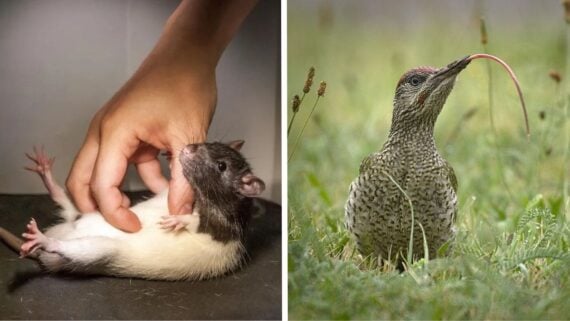
1. Rats laugh when they’re tickled

Scientists have recorded high-pitched chirping sounds from rats during play and tickling. These noises are linked to positive emotions and social bonding. Evolution likely kept this behavior because playful interaction helps young rats learn social skills. In other words, laughter is not just human; it is a social survival tool.
2. Bananas are berries, but strawberries are not

Botanical definitions depend on how a fruit develops from a flower. Berries come from one flower with one ovary, which fits bananas. Strawberries form from multiple ovaries, so they fall into a different category. Science does not always match what we casually call things.
3. Antarctica is technically a desert

Deserts are defined by low precipitation, not heat. Antarctica gets very little snowfall each year, especially inland. The air is so cold that it cannot hold much moisture, which makes it a frozen desert rather than a sandy one.
4. A “jiffy” is an actual scientific term

In informal use, it means a very short time, but scientists have given it precise meanings in different fields. In electronics and physics, it can refer to tiny fractions of a second. The exact value depends on context.
5. Fruit flies were the original astronauts

They were launched on rockets to help scientists understand how radiation and space travel affect living tissue. Researchers selected them because they reproduce quickly and have genetic traits similar to humans. What scientists learned from these experiments helped lay the groundwork for future human space missions. Even these tiny insects ended up playing a small but meaningful role in the history of space exploration.
Trending on The Scroller


6. The Eiffel Tower grows in the summer heat

Heat causes metal to expand at the molecular level, so when temperatures rise, the atoms jiggle more and take up a little extra space; that’s why in warm weather an iron structure like the Eiffel Tower can grow by about 6 inches. As temperatures fall again, the metal contracts and the structure returns to its cooler-season height, a reminder that even solid-seeming landmarks aren’t completely still but subtly shift with the seasons due to thermal expansion and contraction.
7. Cows have best friends

Studies show cows prefer to spend time with certain companions and become stressed when separated. Social bonds help reduce anxiety in herd animals, and these strong relationships improve their well-being. I guess friendship is not just a human need.
8. A teaspoon of soil is packed with life

Soil is full of life, including bacteria, fungi, protozoa, and tiny invertebrates that work together to break down organic matter and recycle nutrients back into the ecosystem. Because of this constant activity, healthy soil is far more alive than it appears at first glance, with entire miniature ecosystems thriving just beneath your feet.
Sign up for our newsletter
9. The first computer “bug” was an actual moth

In 1947, engineers discovered a moth stuck in an early computer, which made it stop working. They removed it and called it the first real “computer bug.” It’s a simple reminder that even tiny things can mess up complicated systems, and it’s also where the term we still use today came from.
10. A dog’s sense of smell can detect disease

Dogs have millions more olfactory receptors than humans, allowing them to detect subtle chemical changes in human bodies. They can detect conditions such as cancer or diabetes by sniffing sweat or breath. Their extraordinary noses give them abilities far beyond our senses. Evolution has fine-tuned their sense of smell for survival and companionship.
11. Cows can see almost 360 degrees

With eyes on the sides of their heads, cows can monitor nearly all of their surroundings for predators. This wide field of vision compensates for their poor depth perception. Being alert while grazing is a key evolutionary advantage.
12. A bolt of lightning is five times hotter than the sun’s surface

A typical strike can reach 30,000 kelvins, far hotter than the Sun’s 5,500 kelvins. The heat causes air to expand explosively, creating thunder. Lightning packs immense energy in a split second because electrical potential builds up so intensely.
13. Sound travels faster in water than in air

Water is denser than air, so sound travels faster through it. That’s why animals like whales can communicate over long distances underwater. The thicker medium moves energy more efficiently, and physics shows that waves always behave differently depending on what they’re moving through.
14. A group of ferrets is called a business

Ferrets are highly social animals that move and hunt in coordinated ways. Old English vocabulary assigned whimsical collective nouns to animal groups. The term “business” captures the busy and energetic nature of ferrets. Language often reflects how humans interpret animal behavior.
15. Polar bears have black skin under their white fur

Their black skin soaks up sunlight really well, which helps them stay warm in the freezing Arctic. At the same time, their white fur blends in with the snow and ice, keeping them hidden from predators and prey. In many animals, color isn’t just about looking a certain way; it’s a smart balance between staying safe and saving energy.
16. A single teaspoon of a neutron star would weigh about six billion tons

Neutron stars are remnants of collapsed massive stars, where gravity compresses matter to extreme density. A tiny amount contains mass equivalent to billions of tons on Earth. Extreme physics creates objects far beyond anything humans would think is possible.
17. The place with the largest name in the world has over 85 letters

Taumatawhakatangihangakoauauotamateaturipukakapikimaungahoronukupokaiwhenuakitanatahu. It preserves history and legend in a single word. Language can serve as both communication and cultural memory, even if it’s unusually long.
18. Sloths can hold their breath longer than dolphins

Sloths can slow their heart rate and metabolism, allowing them to survive underwater for up to 40 minutes. Dolphins, by comparison, rely on rapid breathing at the surface and typically hold their breath for only about 10 minutes. This adaptation helps sloths evade predators while crossing rivers. Evolution has tailored their physiology for survival in both trees and water.
19. A hummingbird’s heart can beat up to 1,260 times per minute

Hummingbirds have extraordinary metabolisms to sustain hovering flight and rapid wing movement. Their hearts beat incredibly fast to deliver oxygen and nutrients to muscles. High energy output is necessary for survival and feeding efficiency. Evolution has designed them for extreme endurance despite their tiny size.
20. The tongue of a woodpecker wraps around its brain for protection

Woodpeckers have long tongues that coil around the skull to act as a shock absorber. This prevents brain injury during repeated pecking. Their unique anatomy allows them to feed without risking damage from their own hammering.
Want to see more fun content?
Check out 20 Funny Signs That Clearly Gave Up on Being Polite, or take a look at 30 Restaurant Food Fails That Deserve A Full Refund. Finally, if you want to see 20 Home Renovation Fails People Need A Refund For.