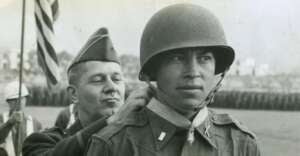
Many of these men and women were just ordinary citizens called to serve in extraordinary times. Their contributions may not have made front-page news, but they played a vital role in shaping the outcome of the war. Let’s dive into 15 American heroes who deserved spots in the history books but didn’t.
1. Charles W. David Jr.

David served in the Coast Guard during World War II. When the USAT Dorchester was torpedoed off the coast of Greenland, he dove repeatedly into freezing waters, pulling others to safety despite the deadly conditions. After rescuing nearly a dozen men, he collapsed from exhaustion and developed pneumonia. His sacrifice cost him his life, but saved many others.
2. Virginia Hall

Born with a passion for adventure and defiance, Virginia Hall became one of the most dangerous spies in occupied France, despite having a prosthetic leg. Working for the British SOE and later the American OSS, she organized resistance cells, gathered intelligence, and coordinated supply drops in German-occupied territories. The Gestapo dubbed her “The Limping Lady” and made capturing her a priority. She evaded them time and again, slipping through their fingers with nerves of steel.
3. Doris Miller

As a mess attendant in the segregated Navy, Doris Miller wasn’t expected to see combat. But when Japanese planes attacked Pearl Harbor, he rushed to an unmanned anti-aircraft gun and fired back, despite never being trained on the weapon. He also carried injured crewmates to safety amid flames and falling debris.
4. Elmer Bigelow

In early 1945, a Japanese shell pierced the USS Fletcher near its ammunition magazine. Without hesitation, Elmer Bigelow grabbed a firehose and entered the blazing compartment, knowing it could explode at any moment. He managed to extinguish the fire, saving the ship and many crewmates, but suffered fatal burns in the process. His bravery was recognized with the Medal of Honor, though his story remains little known outside Navy circles.
5. Joseph Medicine Crow

During combat in Europe, he fulfilled the four sacred tasks required to become a war chief. Those tasks were touching a living enemy, stealing an enemy’s horse, taking a weapon in combat, and leading a successful war party. He achieved all this while serving in the U.S. Army. After the war, he became a historian and advocate for Native American veterans, blending tradition and service in a remarkable life.
Trending on The Scroller
6. Ruby Bradley

A career Army nurse, Ruby Bradley, found herself captured by Japanese forces in the Philippines in 1941. While imprisoned in a civilian internment camp, she secretly helped deliver over a dozen babies and assisted in hundreds of surgeries, smuggling in medical supplies hidden in clothing. Starving and frail by the time of her rescue, she weighed barely 85 pounds. After the war, she returned to service in Korea and retired as one of the most decorated women in U.S. military history.
7. Ben Kuroki

Growing up on a Nebraska farm, Ben Kuroki never imagined he’d become the face of patriotism for Japanese Americans during WWII. After Pearl Harbor, he volunteered for the Army Air Forces and fought to be allowed into combat, eventually flying 58 missions, including dangerous bombing runs over Germany and later Japan. Facing racial prejudice from both the military and the public, Kuroki proved his loyalty again and again. He later spoke out about civil rights and helped bridge understanding after the war.
8. Milton Ernest Ricketts

During the Battle of the Coral Sea, Lieutenant Ricketts was in charge of a damage control party aboard the USS Yorktown. When a bomb exploded in his section, he was mortally wounded, but still managed to close a crucial valve to prevent fuel from igniting further. He then directed firefighting efforts until he collapsed. His actions helped preserve the ship during one of the war’s pivotal early naval battles.
Sign up for our newsletter
9. Ernest Childers

Born in Oklahoma and a member of the Muscogee (Creek) Nation, Childers overcame a broken ankle to lead an assault on German positions in Italy. Crawling under fire, he singlehandedly captured multiple enemy soldiers and took out two machine gun nests. His leadership inspired his men and turned the tide of the skirmish. He became the first Native American in WWII to receive the Medal of Honor.
10. Margaret E. Bailey

A trailblazer in military medicine, Margaret E. Bailey was one of the first African American nurses commissioned in the Army Nurse Corps during WWII. Despite being restricted to segregated units, she worked tirelessly under challenging conditions, caring for wounded soldiers and prisoners of war. Her dedication and competence helped erode the military’s discriminatory policies from within. After the war, she became the first Black woman to reach the rank of colonel in the Army Nurse Corps, breaking barriers for generations to come.
11. William E. Dyess

A fighter pilot turned prisoner of war, Dyess survived the Bataan Death March and brutal captivity in a Japanese prison camp. After months of starvation and torture, he led a daring escape. This escape was the only large-scale breakout by American prisoners in the Pacific. He made it back to American lines and provided firsthand accounts of Japanese atrocities, helping to expose the harsh realities of POW life.
12. Frances Slanger

Frances Slanger was the first American nurse to land on the beaches of Normandy, and the only American nurse to die in action in Europe during the war. A Jewish immigrant from Poland, she volunteered to serve with frontline units, treating wounded soldiers under fire. The night before her death, she wrote a heartfelt letter to Stars and Stripes thanking American GIs for their courage, humility, and kindness. The letter was published after her death and touched thousands, a final testament to her compassion and bravery.
13. Richard Sorenson

A Marine stationed in the Pacific, Sorenson was just 19 when he earned the Medal of Honor for throwing himself on a live Japanese grenade to save five of his fellow Marines during the Battle of Namur. Miraculously, he survived the blast, though he was gravely wounded. His selfless act was later called one of the most heroic moments in the war. Sorenson recovered and went on to live a quiet life, avoiding the spotlight his courage deserved.
14. Leonard Funk Jr.

A paratrooper with the 82nd Airborne, Leonard Funk Jr., played a pivotal role during the Battle of the Bulge. When a group of over 80 German soldiers captured several American troops, Funk, despite being heavily outnumbered, opened fire and retook control of the situation. His quick action led to the recapture of all the Americans and the surrender of the German troops. He was awarded the Medal of Honor but remains relatively unknown outside of military history circles.
15. Ola Mildred Rexroat

A member of the Oglala Lakota tribe, Rexroat was the only Native American woman to serve in the Women Airforce Service Pilots (WASP) during WWII. She ferried planes and towed aerial gunnery targets, tasks that came with enormous risk and little recognition. After the war, she continued her aviation career with the Air Force and later worked as an air traffic controller. Her legacy helped challenge both gender and racial norms in American military aviation.
Want to see more content from World War 2?
Check out 20 Colorized Photos from World War II, or take a look at 20 Photos Of Historical Figures That Shaped the Course of World War 2. Finally, if you want to see photos of UK tanks from WW2, check out 23 Vintage Pics of UK Tanks From WW2.