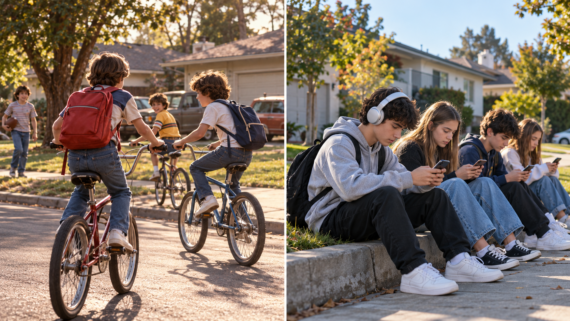
Growing up in the 1980s meant a different kind of childhood. There were no smartphones in your pocket, no group chats to coordinate plans, and no location-sharing apps telling your parents exactly where you were. A lot of everyday routines looked completely different.
Today’s kids and teenagers grow up with more digital access, different family routines, and changing expectations around school, work, and safety. Some changes have made childhood healthier or safer, while others have introduced new challenges. Here are 17 ways growing up in America has changed since the 1980s
Smartphones Became Practically Essential for Teenagers

In the 1980s, carrying a camera, map, music collection, and instant messaging service in one pocket would have sounded like science fiction. In 2024, 95% of U.S. teens ages 13 to 17 had or had access to a smartphone at home. Back in 2011, just 23% of teens ages 12 to 17 owned one. The flip phone had a good run, but it never stood a chance.
Nearly Half of Teens Are Online Almost Constantly

Going online used to mean sitting down at a computer, and sometimes waiting for someone to get off the phone. Now, the internet follows teenagers through schoolwork, entertainment, shopping, and friendship. In 2024, 46% of U.S. teens said they were online almost constantly, up from 24% in 2014-15. Nearly all teens reported using the internet every day. Logging off has become a surprisingly ambitious activity.
Walking or Biking to School Became Much Less Common

For many American kids, getting to school once meant walking with friends or riding a bike. Federal transportation data show that 47.7% of K-8 students walked or biked to school in 1969, compared with about 13% in 2009. Longer distances, suburban growth, traffic concerns, and greater reliance on cars all played a role. The school run has increasingly become a job for parents rather than kids.
Car Rides Became a Lot More Regulated

A child riding in the back seat without a properly fitted restraint was once much more common. Tennessee passed the first state child-restraint law in 1978, and by 1985 every state and Washington, D.C., had some form of child passenger-restraint requirement. Rules have since expanded to cover older children, booster seats, and more seating positions. The family road trip now comes with considerably more safety instructions.
Getting a Driver’s License at 16 Is No Longer a Given

For generations, turning 16 meant one major milestone: getting behind the wheel. But that tradition has become less common. In 1983, 46.2% of 16-year-olds had a driver’s license. By 2023, the figure had fallen to 25.2%, according to Federal Highway Administration data. Seventeen-year-olds have also seen a decline. Between rides from parents and digital ways to socialize, the freedom of the open road isn’t quite the universal teenage dream it once was.
Trending on The Scroller


Teenagers Are Less Likely to Have Part-Time Jobs

Teenage jobs used to be a more familiar part of growing up, whether it meant working a summer shift or earning spending money after school. In 1980, 56.7% of Americans ages 16 to 19 participated in the labor force. In 2025, the rate was 36.2%. School demands, summer programs, changes in industries, and competition for entry-level jobs have reshaped the landscape. The classic after-school shift isn’t as common as it used to be.
Teen Cigarette Smoking Became Much Less Common

Cigarettes were far more common among American teenagers a few decades ago. In 1991, 27.5% of U.S. high school students were current cigarette smokers, according to the CDC. By 2023, cigarette smoking had fallen to very low levels among young people, while e-cigarettes had become the more common nicotine product. That’s a major shift, although the decline in cigarettes doesn’t mean every concern about teen nicotine use has disappeared.
Teen Birth Rates Fell Dramatically

Teen parenthood was much more common in the early 1990s than it is today. The U.S. birth rate for females ages 15 to 19 reached 61.8 births per 1,000 in 1991. By 2024, it had dropped to 12.6 per 1,000, a decline of nearly 80%. It’s one of the biggest changes in the statistics surrounding American adolescence, showing just how much the experience of growing up has shifted over a few decades.
Sign up for our newsletter
Childhood Obesity Became Much More Common

Not every change in childhood has been an improvement. CDC data show that obesity affected about 5.5% of U.S. children and adolescents ages 2 to 19 in 1976-1980. By 2017, through March 2020, the figure had risen to 19.7% or roughly one in five young people. It’s a significant public-health shift, and a reminder that changes in food, activity, and daily routines can bring serious consequences.
Children’s Exposure to Lead Fell Enormously

Children growing up around 1980 faced far higher lead exposure than children do today. Between 1976 and 1980, an estimated 88% of U.S. children ages 1 to 5 had blood-lead levels of at least 10 micrograms per deciliter. By 2007-2010, that share had fallen to 0.8% following measures including removing lead from gasoline and restricting lead in paint. It’s a public-health success story that doesn’t get nearly as much attention as it deserves.
More Young Children Started Preschool Before Kindergarten

Formal education increasingly begins before kindergarten. In 1980, about 4.9 million American children ages 3 to 5 were enrolled in preprimary programs. By 2015, that number had grown to roughly 7.7 million. Enrollment among 3-year-olds rose substantially over the longer postwar period as preschool and nursery-school programs expanded. For many families, the school routine now starts years before the first day of kindergarten.
Finishing High School Became Much More Common

A larger share of young Americans now completes high school than did in 1980. The National Center for Education Statistics reported a completion rate of 83.9% among 18- to 24-year-olds who were no longer enrolled in high school that year. By 2022, the rate had reached 94.4%. The measure includes traditional diplomas and alternative credentials such as the GED. Graduating has become much more common, even if the homework still feels endless.
Growing Up With Two Married Parents Became Less Universal

American family life looks more varied than it did several decades ago. Pew Research Center’s analysis of Census data found that 77% of U.S. children under 18 lived with two married parents in 1980, compared with 63% in 2024. Single-parent, unmarried-parent, blended, and other household arrangements now account for a larger share of childhood experiences. There’s no single family setup that captures what growing up looks like for everyone.
Fathers Started Spending More Time Caring for Their Kids

The role of fathers in everyday childcare has changed substantially since the mid-20th century. Pew Research Center found that fathers spent an average of 2.5 hours per week caring for children in 1965, compared with 7.3 hours in 2011. That reflects a broader shift toward more hands-on parenting by fathers. Diaper duty, school pickups, and bedtime routines are no longer quite as automatically assigned to one parent.
Bicycle Helmets Became a Normal Part of Childhood

In the 1980s, seeing kids ride bikes without helmets was far more common. Over the following decades, public-health campaigns, product standards, and youth helmet laws helped make protective headgear a more familiar part of cycling. NHTSA identifies properly fitted bicycle helmets as one of the most important ways to reduce the risk of head and brain injuries in a crash. The helmet may mess up your hair, but that’s a pretty reasonable trade-off.
Kids’ Entertainment Became Much More Interactive

In the 1980s, entertainment often meant broadcast television, an early home gaming console, or watching whatever happened to be on. Today’s young people can choose from streaming video, online games, social platforms, and on-demand content. In 2024, 83% of U.S. teens had access to a gaming console at home, while 70% had access to a tablet. The biggest difference might be that kids no longer have to wait for their favorite show to come on.
Parents Can Monitor Teenagers in Ways That Didn’t Exist Before

Parents in the 1980s couldn’t text their teenagers throughout the day, check their phone’s location, or review their screen time from another room. Smartphones have made all of that possible. In 2024, half of parents of teenagers said they had looked through their teen’s phone, while 38% of both parents and teens said they at least sometimes argued about how much time the teen spent on it. Staying connected has never been easier, or more likely to start an argument.